
Employee Wellness Program: Benefits, Types, Examples and Complete Guide

Employee wellbeing programs can be used by organizations to build a healthier and caring working environment while at the same time placing some of the responsibility for employee wellbeing on the employees themselves. Programs are designed according to the organization but might include fitness challenges, medical assessments, nutrition guidance, stress management tools, flexible work and workshops related to health topics.
A good program should be more than an annual subscription to a gym or a health event once in a while. They are most effective when the activities provided are relevant to the employees, convenient and fostered by the workplace culture.
Quick answer: Wellness programs are workplace initiatives that enable and support employees in developing and attaining healthy behaviors by addressing and meeting the needs for healthy activities, education, programs and services designed around individual workplace preferences and resource capabilities of an organization and employee population.
This Article Is Part of the Fitness Events Hub
Discover proven fitness strategies, workout plans, strength training techniques, cardio exercises, recovery tips, and healthy lifestyle advice in our Fitness Events Hub.
What Is an Employee Wellness Program?
An employee wellness program is a set of designed events and activities that employers can offer within a business environment to promote an employee’s health and well being.
Everything can range from simple challenges such as establishing a fitness walking mission through health club passes/perks, healthy instruction, therapy help providers, healthcare, along with other tools. Exactly what you will choose is based on a variety of facets, including:
- Organisation size
- Employee demographics
- Work environment
- Available budget
- Remote or hybrid working arrangements
- Employee interests
- Existing health and safety policies
Another should recognize worker privacy: the decision should also comply with worker privacy for such things as health wellness participations. Usually employee involvements in health matters, such as, should remain voluntary.
Types of Employee Wellness Programs
There is no single model that works for every organisation.
-
Physical Fitness Programmes
These can include:
- Workplace fitness classes
- Walking or step challenges
- Gym memberships
- Yoga sessions
- Stretching sessions
- Sports activities
- Fitness assessments
For office-workers, an employee initiative could be as simple as movement encourages. Simply, taking the breaks, from all the sitting around that day can have a real difference.
-
Initiatives focused on mental wellbeing:
In addition to these ideas focusing on wellbeing at work, psychological and emotional health may also be targeted.
Examples include:
- Stress-management workshops
- Mindfulness sessions
- Employee assistance resources
- Mental wellbeing education
- Access to counselling services
- Manager training on workplace wellbeing
Workplace wellness programs should not be considered a substitute for medical treatment by employers.
-
Nutrition and Healthy Life Styles programs
Nutrition programs may include:
- Healthy eating workshops
- Nutrition education
- Healthy workplace meals
- Hydration campaigns
- Cooking demonstrations
- Access to qualified nutrition professionals
What needs to be emphasized is health education, not restricted diets or impractical weight-loss goals.
-
Health Promotion
Programs offered by certain organizations can be health education and preventive services such as:
- Health awareness campaigns
- Vaccination programmes where appropriate
- Health screenings
- Ergonomic assessments
- Preventive health education
The access and correct provision of these services may rely on the local regulations, company policies and qualified doctors.
Advantages of employee wellness programs

A good program can benefit the employees and the organization, the results will however vary and cannot be guaranteed.
| Potential benefit | How it may help |
| Improved health awareness | Employees can learn more about healthy habits |
| Physical activity | Encourages regular movement |
| Stress management | Provides practical coping resources |
| Employee engagement | Can create opportunities for participation |
| Workplace culture | Demonstrates organisational support |
| Preventive awareness | Encourages appropriate health checks |
| Social connection | Group activities can encourage interaction |
You need to be realistic about what outcomes you can achieve. There are lots of solutions to workplaces problems of the mind, body or productivity not solely a wellness programme alone.
For evidence-based guidance on improving employee health and wellbeing in the workplace, see the CDC’s workplace health resources.
How to implement an employee wellness program.
A possible implementation procedure may be broken down into several steps.
- Step: Identify employee interests Use anonymous surveys, comments forms or volunteer participation data to determine what your employees want to focus on.
- Step: Define your goals Make your goals specific.
- Are you hoping to improve physical activity, wellbeing knowledge, participation or access to health resources?
- Step: Choose appropriate activities Select what is feasible for your employees. Remote employees may prefer virtual courses or digital assets, while office employees may appreciate on-site programs and activities.
- Step: Set privacy and participation rules Clearly communicate what data you collect, what its access parameters are, and whether you mandate the participation level.
- Step: Implement in stages Starting with a few key initiatives is a more manageable way of identifying how the employees want to participate and improving it later on.
- Step: Measure and adapt Consider employee participation, comments, and relevant workplace metrics. Don’t focus on just one metric.
Examples of Employee Wellness Programs
A small business does not need big bucks to start out. Take an example as:
- Monday: 10 min guided stretch
- Tuesday: Wellness eating information sheet
- Wednesday: Walk or movement challenge
- Thursday: Stress management session
- Friday: Group fitness optional activity
This could expand in a bigger organisation’s repertoire to include health and nutrition advice, employee wellbeing support, exercise facilities and online lifestyle solutions. Consistency is crucial; the one off event might stimulate initial enthusiasm but genuine sustained interest usually necessitates something sustainable, convenient, and accessible.
Remote Employee Wellness Program:
For Remote or Hybrid-Working Staff It’s possible that, under a typical employee wellness programme, yourremote orhybrid-working teammembers don’t easily get engaged.
Useful options include:
- Virtual fitness sessions
- Online wellbeing workshops
- Digital step challenges
- Ergonomic workstation guidance
- Flexible activity breaks
- Online educational resources
- Virtual social activities
Avoid pressuring staff to be available outside normal working times at all costs.
Employee Wellness Program Expectations
While programme expectations should be set realistically. Programme outcomes could involve employees adopting new healthy practices and/or utilizing resources, with the willingness varying across workforce members; individuals will gravitate toward different interest areas, such as fitness, Nutrition, Stress Management or Workplace ergonomics etc.
In addition, an employer would not want to automatically expect better health costs and /or better organisational output to directly correlate with employees’ involvement; this also depends upon external factors. Evaluating programme outcomes should consist of both, participation, employee perceptions of the program, the programme itself and organisational metrics.
Pros and Limitations
| Pros | Limitations |
| Supports health awareness | Participation may be low |
| Can encourage physical activity | Requires ongoing management |
| Provides useful educational resources | Costs vary by programme |
| Can support workplace culture | Not every activity suits everyone |
| Flexible programmes can suit different employees | Privacy must be handled carefully |
Who Should Consider an Employee Wellness Program?
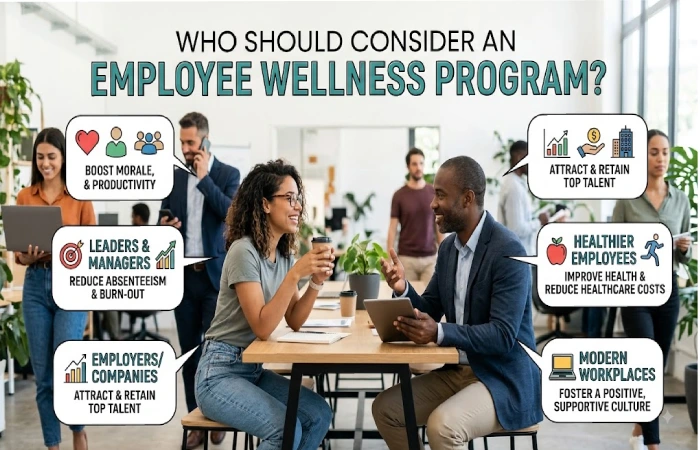
An employee wellness program would be great for:
- Small and medium-sized businesses
- Large corporate workplaces
- Educational organisations
- Healthcare organisations
- Remote and hybrid teams
- Organisations seeking structured wellbeing initiatives
Nonetheless, programme design must always take account of the particular workforce and, as a result, never simply copy an existing programme.
How To Evaluate Your Employee Wellness Program
Here’s what some common metrics may be useful for evaluating a well-rounded wellness program::
- Participation rates
- Employee satisfaction
- Workshop attendance
- Feedback surveys
- Use of available wellbeing resources
- Activity completion rates
- Changes in programme engagement over time
Organizations should implement suitable privacy controls for sensitive health information and also refrain from collecting more personal data than is necessary.
FAQs
What is employee wellness?
An employee wellness program is a corporate initiative that offer activities, education and resources designed to help employees take care of their physical and general wellness.
What can my company do to ensure the health and success of their employees through its program?
Potential benefits may include enhanced health consciousness, increased avenues for physical activity, greater access to health information, and improved employee workplace involvement. Outcomes are varied amongst companies.
What are employee wellness programs examples?
Examples of Employee Wellness programs include; fitness classes, walking challenges, nutrition guidance, stress reduction techniques, ergonomics tips and resources, health awareness, employee wellbeing workshops and guides, to mention few.
How Much does it cost?
The cost varies greatly from simple, free programmes (walking challenge, health topic discussions) to more extensive programmes which may include, professional service providers, software and online tools, screening activities and fitness centres or gyms.
Is it illegal to not take part in employee wellness programs?
Whether participation or certain on-site health programs are compulsory is determined by the company’s policy, applicable regional labor law, and the nature of the wellness program. In many cases participation in such programs may be optional.
Conclusion
Employee wellbeing programs can be a great resource for both organisations to promote positive workforce behaviours and for employees to take advantage of valuable support and resources. The best plan needn’t be the costliest. Simply start by knowing your employee needs, choose activities that are both feasible and within budget, respect employee privacy, and remember that long-term monitoring and measurement are crucial.
Wellness Program Hub
Explore the complete Wellness Program guide, including employee wellness programs, corporate wellness ideas, workplace wellness benefits, program creation, activities, and examples.