
Wellness Program Activities
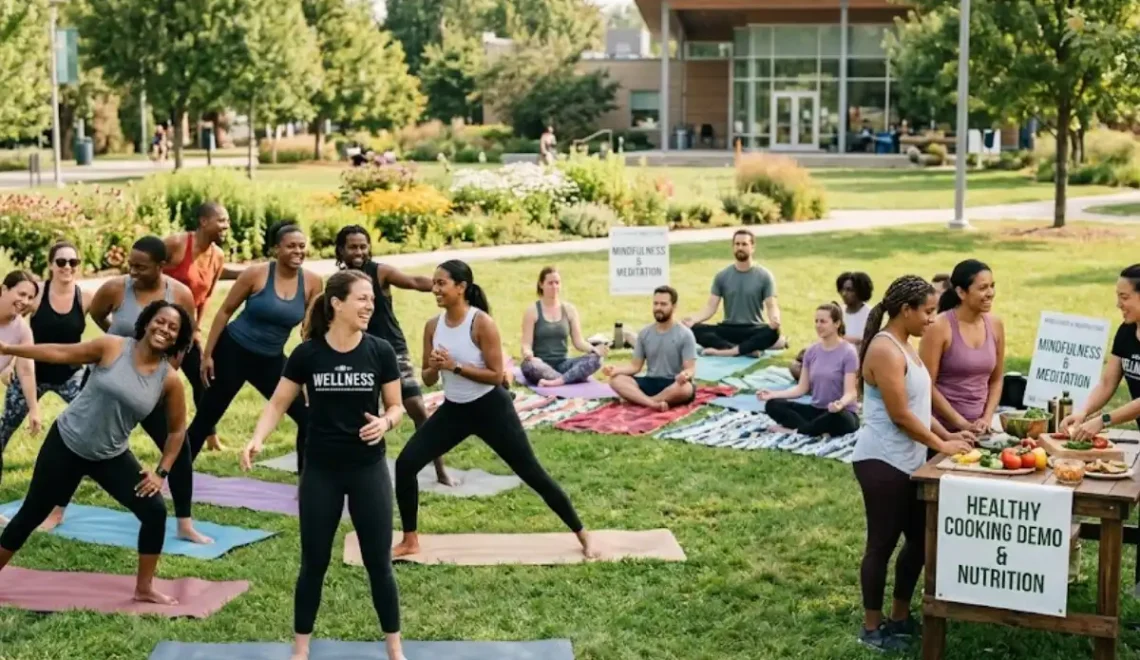
Workplace wellness program activities allow employees to find practical methods to help with their physical health, mental wellness, and social connections during or alongside the workday.
Workplace program activities do not require a large budget or much thought to be extremely beneficial for employees. The most effective type of workplace program activities should be easy for staff to access, fit in with their work, and not restrict work performance.
Allowing staff various options is another key to ensuring the success of the program activities because the majority of people are not motivated by fitness challenges or group-based activities.
This guide includes an overview of simple yet helpful employee wellness activities, workplace fitness concepts, office health challenge activity types, team well-being activity ideas, and mental wellness activities and office ideas that companies can implement into their workplace.
Activities could be work-related walks, a short workout, teaching about healthy food, stress management activities, health challenges, and employee get-togethers to work on their mental well-being together. Employers need to take employee interests, access, amount of funds/space, and needs into account.
This Article Is Part of the Fitness Events Hub
Discover proven fitness strategies, workout plans, strength training techniques, cardio exercises, recovery tips, and healthy lifestyle advice in our Fitness Events Hub.
What Are Wellness Program Activities?
Wellness program activities are organized programs with the objective to motivate employees towards healthier life practices and equip employees with tools that support well-being. There are three main types of initiatives.
- Physical activity
- Mental well-being
- Nutrition
- Stress management
- Social connection
- Workplace ergonomics
- Health education
- Healthy lifestyle habits
A program can take place either individually or as a group.
For instance, an individual could use on-site exercise equipment daily, but there could also be an optional, individual-led, staff walking group held weekly.
Employees will not necessarily want to take part in all aspects of an employee program, and companies must create options to meet a range of interests and capabilities.
Employee Wellness Activities
Employee wellness activities should be functional, accessible, and voluntary.
Walking groups
A walking group can be one of the simplest workplace wellness activities. It could also help support any team that does not currently operate as a desk-based operation.
Group walks can take place during a suitable lunch or break time, before or after work. Virtual walking could take place online using some step tracking feature or via an informal check-in function.
Healthy eating workshops
At workplace nutrition workshops and talks, participants need to feel that they have received relevant healthy eating advice which can easily be put into practice. Subjects of healthy eating workshops or talks could be the following:-
- Balanced eating
- Healthy snacks
- Reading food labels
- Healthy drink options
- Preparing a simple meal
The workshops shouldn’t be about restrictive diets and ‘dieting.’
Stretching sessions
A session that focuses on short stretching and body movement sessions could help support those employees who may suffer effects of prolonged periods of sitting down. These should ideally be brief, practical, and suitable for everyone, not putting anyone on the spot to perform movements that are unsuitable or painful for them to perform.
Health education sessions
Organizations could offer sessions hosted by qualified employees to discuss various work-relevant topics with them; these could include subjects such as how to improve quality of sleep, importance of physical activity, proper nutrition, and how to manage stresses associated with working.
Workplace Fitness Activities
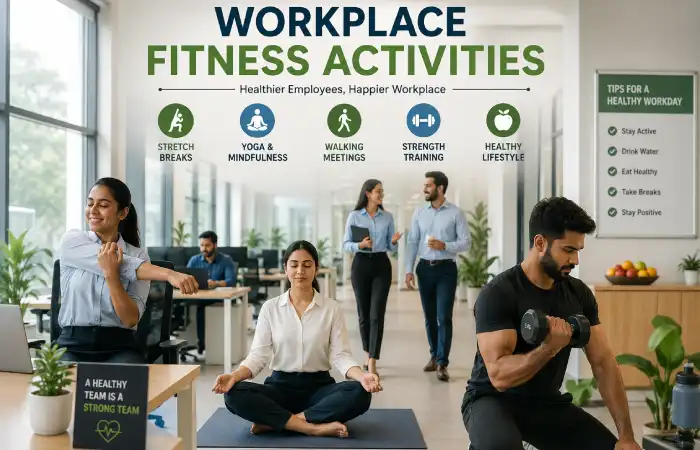
Workplace fitness activities are varied, covering a spectrum that goes from a few quick motion breaks to highly programmed exercise sessions.
| Activity | Suitable format |
| Walking group | In-person or hybrid |
| Stretching | Office or online |
| Yoga | Group session |
| Fitness class | Office or external venue |
| Stair challenge | Individual/team |
| Mobility session | Short workplace break |
| Sports activity | Team event |
Ensure activities are inclusive
The physical capability and fitness level of each employee will vary.
A program that focuses solely on weight loss, speed, and athletic achievement might alienate some employees.
Low-impact exercise options should be included in the overall activities—for example, in a step challenge, this means employees could be involved through various movements other than just hitting a daily step target.
Office Health Challenges
Adding challenge to the office health program adds that extra level of excitement through offering a specific goal within a specific timeframe. Office health challenge ideas could include:
- Hydration challenge: Where staff could try to sip adequate amounts of water throughout the day.
- Movement-break challenge: Participants could be encouraged to insert mindful movement breaks throughout their working day at appropriate points.
- Walking challenge: whereby team members log any walking and movement performed over a set timeframe.
- Healthy lunch challenge: The workforce shares ideas around creating balanced and easy lunches.
- Sleep Education Challenge: The workforce participates in a short program centered around establishing healthy sleep habits.
- Challenges should be entirely optional: Never use private health information that might identify employees.
Employers can encourage healthier workplaces through simple movement breaks, walking programmes, and other activities, as recommended by the CDC’s workplace physical activity resources.
Mental Wellness Activities
As the discussion above on work and wellness highlights, physical wellness is important, but there are other dimensions. Activities focusing on mental well-being will allow employees to gain knowledge and resources concerning emotional health and stress.
Suggested activities:
- Guided breathing sessions
- Mindfulness sessions
- Stress-management workshops
- Quiet breaks
- Digital wellbeing education
- Time-management workshops
- Access to employee assistance resources
- Mental health awareness sessions
These are not designed to be a replacement for professional mental health services. It should be clear where someone needs to access clinical support services through either making them available or signposting to elsewhere.
Supporting a positive environment
Your wider work environment will have a big impact on your well-being. A five-minute meditation probably won’t fix excessive work demands, poor management, or impossible deadlines. Wellness programs should simply support good workplace behavior.
Team well-being activities
Team well-being activities can integrate socializing opportunities with well-being practices.
Ideas include:
- Group walks
- Team sports
- Healthy cooking sessions
- Outdoor activities
- Volunteering
- Wellness workshops
- Fitness classes
- Social wellbeing events
There should be an effort to create emphasis on participation over competition.
An example would be with a team walking challenge where participants would feel encouraged to achieve some individual level of participation rather than be rewarded for having the most step counts.
It might be more appropriate with different abilities of the employees and timings.
Planning the Activities in your wellness program
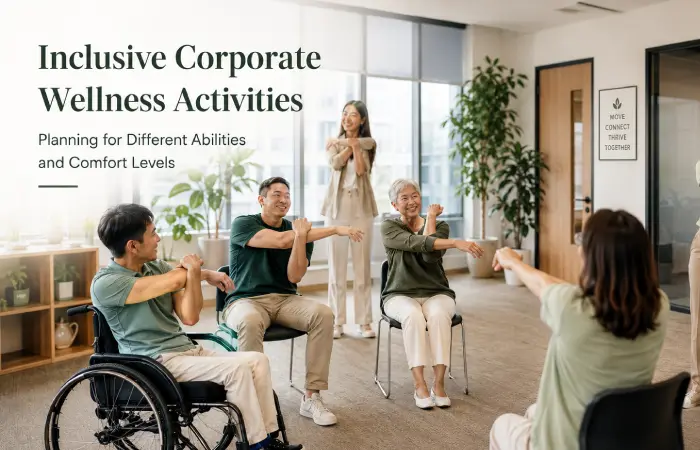
Randomly selecting activities can lead to minimal participation, so establishing a straightforward planning structure is more practical.
-
Understand employee needs
You can carry out surveys or questionnaires or seek employee feedback.
-
Choose a focus or program outcome
Decide whether it’s physical activity or health information or both or social life or psychological health and so on.
-
Select activities
Choose a few suitable, manageable activities.
-
Be aware of accessibility
Consider remote, shift, people with disabilities, and various fitness levels for each activity.
-
Clear and simple communication
Clearly state what the activity would be like, where and when it’s taking place, and how they may participate in it.
-
Seek feedback and measure participation.
Noting attendance and seeking feedback will highlight which programs are found more beneficial for all members.
-
Modify the wellness program.
You can eliminate unpopular program while retaining the ones in popular demand
Sample Month Wellness Plan
Here’s what a four-week wellness program from any firm might look like.
| Week | Activity | Focus |
| Week 1 | Walking group | Physical activity |
| Week 2 | Nutrition workshop | Healthy eating |
| Week 3 | Guided relaxation session | Mental well-being |
| Week 4 | Team well-being event | Social connection |
These programs can be reused or amended according to the feedback from your staff. There isn’t the need for you to start a new initiative each day!
Expectations of the wellness program.
We should not assume that any wellness program can ensure healthy or productive employees. Employee participation might be a factor due to the following:
- Work schedules
- Personal preferences
- Accessibility
- Workload
- Location
- Management support
- Communication quality
An activity with a low turnout might still have been effective—it could have the right purpose, format, and audience but the wrong timing.
Conversely, a successful turnout does not tell us whether an intervention delivered a measurable result in health. This, however, we can ascertain by using a smart evaluation approach that brings together turnout data with feedback and organizational metrics.
Pros and Cons
| Potential benefits | Potential limitations |
| Encourage healthy habits | Participation varies |
| Provide health education | Require organisation |
| Support social connection | Some activities cost money |
| Add variety to the working day | Not every activity suits everyone |
| Can be adapted for remote teams | Results can be difficult to measure |
| Support a well-being culture. | Must complement wider workplace practices |
FAQs
What are wellness program activities?
The definition of wellness activities is the efforts that workplaces undertake in order to encourage workers’ health. Wellness programs will involve group exercising activities, well-being coaching in order to train employees, well-being challenges, and crew get-togethers.
Just what are some good employee wellness activities?
Some useful employee wellness actions consist of staff member stretching routines and walking groups. Various other are often such as team health education courses and also optional wellness challenges.
What are some workplace fitness activities?
Workplace fitness activities are exercises that are suitable for the office environment and include activities like walking groups, yoga, stretching, mobility exercises, fitness classes, and a range of other physical activities.
What are office health challenges?
Office health challenges are brief programs intended to foster health-promoting behaviors, including activity/movement breaks, stretching, hydration, or healthy eating behaviors.
Some employee mental health activities include:
Some examples of these would include mindfulness trainings, breathing workouts, stress education classes, and the use of relevant well-being support.
How can your team wellness activities look?
Team wellbeing activities is a type of collective effort for a group of individuals, which involves interaction amongst people along with a productive or fun activity or even something enjoyable like sports, walking, volunteering, and even wellness workshops for the group.
Conclusion
Well-planned wellness program activities provide practical ways to encourage and build upon the physical health, psychological well-being, and social relationships of employees.
It does not take a dozen wellness activities for an organization to have an effective program. The mix of beneficial employee wellness activities, inclusive workplace fitness activities, optional in-office fitness challenges, sensible in-office psychological well-being activities, and engaging team wellness activities makes for a great beginning.
In this context it will be about knowing employee needs, allowing participation to be optional and easy for all, and clearly communicating activities and program benefits while regularly evaluating its success.
The overall intention behind implementing wellness activities at the workplace will be to add to the benefits offered to employees on top of decent working conditions and adequate workplace policies, rather than use activities as a panacea.
Wellness Program Hub
Explore the complete Wellness Program guide, including employee wellness programs, corporate wellness ideas, workplace wellness benefits, program creation, activities, and examples.