
HIIT Before or After Weights
Introduction
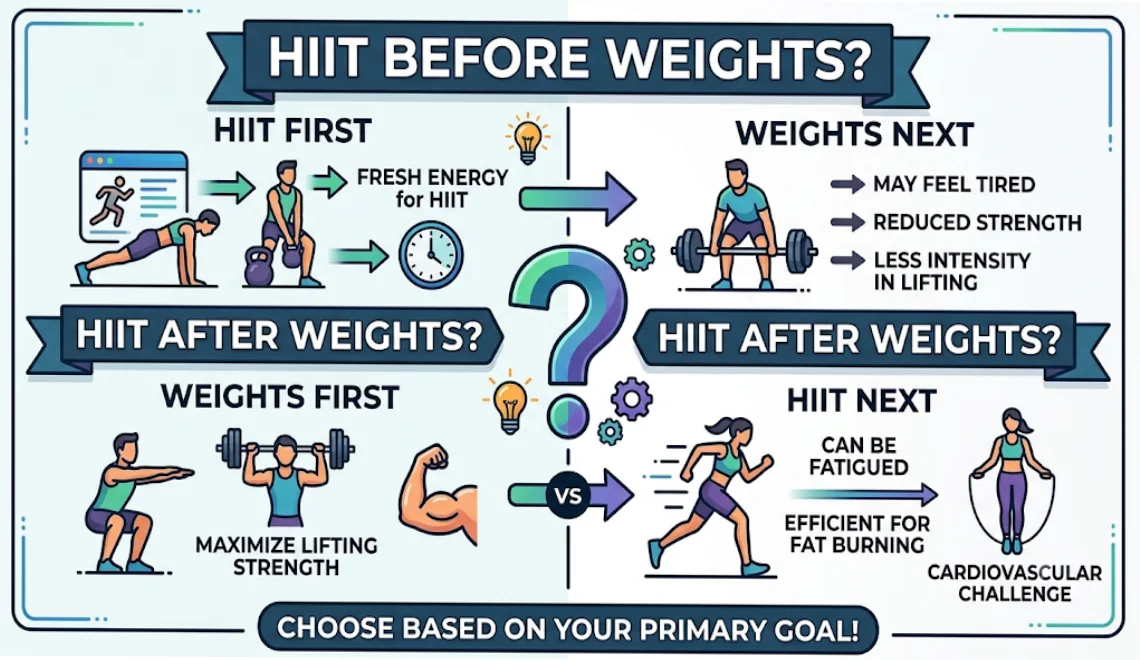
People working out in gyms often wonder if they should do HIIT first or wait until they’ve finished working out with weights. Cardio fitness tips like this are important, as they can affect the intensity and time of all workouts, as well as muscular strength, recovery, and energy levels.
There is not one hard and fast rule that applies to all. The best order of exercises will vary based on your goals—whether they are fat burning, muscle building, athletic enhancement, or just general good health. Learning how HIIT and weight training fit together can be very useful in this context.
This Article Is Part of the Fitness Tips Hub
Discover proven fitness strategies, workout plans, strength training techniques, cardio exercises, recovery tips, and healthy lifestyle advice in our Fitness Tips Hub.
Understanding HIIT and Strength Training
What Is HIIT?
HIIT Before or After Weights: This refers to whether you are doing high-intensity interval training before or after the weight training session that same day. Having a correct before-and-after training order will not only support the quality of your training but also improve recovery time and support exercise based on meeting your fitness goals.
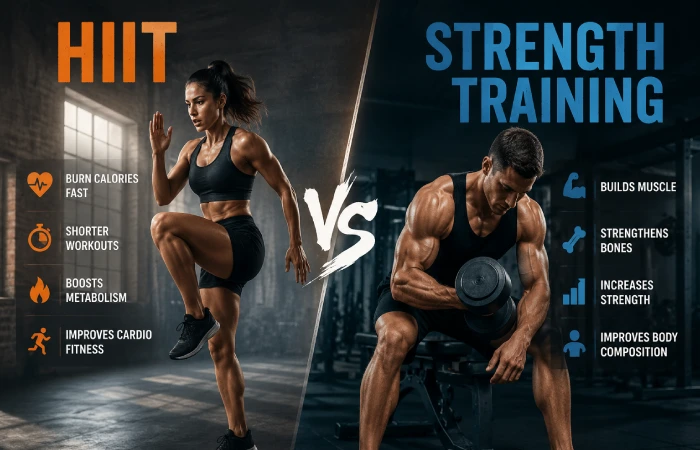
High-intensity interval training consists of a series of low-to-moderate-intensity workouts interspersed with short recovery periods.
Examples include:
- Sprint intervals
- Rowing intervals
- Cycling sprints
- Burpees
- Battle ropes
A standard HIIT workout is about 10-30 minutes long.
What Is Strength Training?
Strength training involves performing resistance exercises to improve the following:
- Muscle mass
- Strength
- Bone health
- Functional fitness
- Metabolic health
Examples include:
- Squats
- Deadlifts
- Bench press
- Overhead press
- Resistance machine exercises
Cardio Fitness Tips: HIIT Before or After Weights?
The bottom line for people that are focused on building muscle and getting strong: Most should definitely stick with weights first. The only reason why you would do HIIT before weights is if conditioning is a key factor for you.
| Primary Goal | Recommended Order |
| Muscle gain | Weights → HIIT |
| Strength development | Weights → HIIT |
| Fat loss | Usually Weights → HIIT |
| Endurance improvement | HIIT → Weights |
| Athletic conditioning | Depends on sport |
| General fitness | Personal preference |
Research shows that HIIT can improve cardiovascular fitness and deliver significant health benefits in a relatively short amount of time. Harvard Health explains these science-backed advantages in its guide on Interval Training: A Shorter, More Enjoyable Workout.
HIIT Before Weight Training: Benefits and Limitations
Possible Benefits
Upgraded Cardiovascular Attention
Performing HIIT before weight training allows maximum effort during interval sessions.
Better Sports Conditioning
Athletes preparing for endurance-based sports may prioritize conditioning first.
Efficient Short Workouts
Individuals with limited training time may prefer completing demanding cardio first.
Potential Limitations
- Reduced energy for heavy lifts.
- Decreased strength performance.
- Earlier muscular fatigue.
- Lower training volume during resistance sessions.
Studies indicate that high-intensity cardio done previous to heavy lifting may perhaps temporarily decrease your maximum power output capability.
HIIT After Lifting Weights: Benefits and Limitations
Benefits of HIIT After Lifting Weights
Greater Strength Performance
Performing resistance exercises first allows muscles to train while energy stores are highest.
Supports Muscle Growth
Strength training demands a certain degree of maximum effort and good technique.
HIIT Workouts to Burn Fat
You may also enhance the calorie expenditure in resistance training by including the HIIT workouts following strength workout sessions without sacrificing the strength training intensity.
Limitations
- Fatigue may reduce HIIT intensity.
- Longer overall workout duration.
- Recovery demands may increase.
HIIT Before vs After Weights
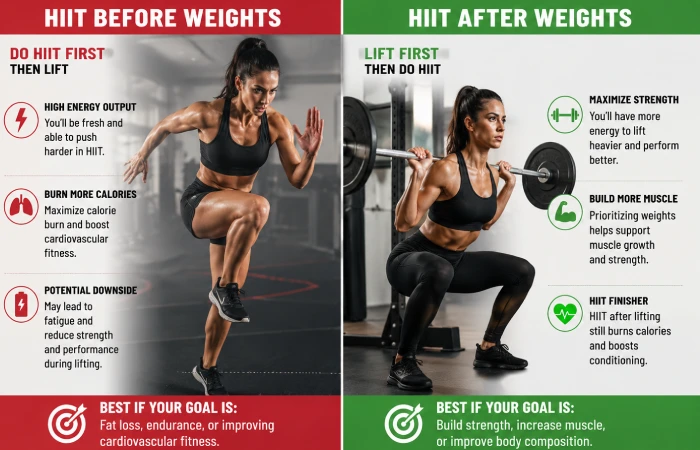
| Factor | HIIT Before Weights | HIIT After Weights |
| Strength Performance | Lower | Higher |
| Muscle Growth Potential | Moderate | Higher |
| Cardiovascular Performance | Higher | Moderate |
| Fat Loss Support | Good | Good |
| Energy for Lifting | Reduced | Optimal |
| Athletic Conditioning | Better | Moderate |
| Injury Risk During Lifting | Slightly Higher | Lower |
What is the best choice for HIIT for fat loss?
It can be combined with cardiovascular training and resistance exercises. Research confirms the total energy intake balance and other elements like nutrient timing and consistency of training are important factors compared to the order of performing the exercises.
HIIT and Strength Training Combined: Your Ultimate Workflow
Step 1: Describe Your Main Goal
Select your primary objective:
- Muscle gain
- Fat loss
- Endurance
- Athletic performance
Step 2: Schedule Resistance Training
Complete compound lifts while energy levels are highest.
Examples:
- Squats
- Bench press
- Deadlifts
Step 3: Add HIIT Session
Do 10-20 minutes of intervals following weights for those focusing on strength.
Step 4: Recover Correctly
Include:
- Protein intake
- Hydration
- Mobility work
- Satisfactory sleep
Example Weekly Plan
| Day | Workout |
| Monday | Upper Body + HIIT |
| Tuesday | Moderate Cardio |
| Wednesday | Lower Body + HIIT |
| Thursday | Active Recovery |
| Friday | Full Body Strength |
| Saturday | Dedicated HIIT Session |
| Sunday | Rest |
How to Manage expectations – how much can you truly expect to gain?
One of the big ones I often get asked about is people assuming that simply changing the order of the workout will have a massive physical transformation effect. But the results really come from various other factors.
Realistic Expectations
After 4-8 weeks of consistent training, you may notice
- Cardiovascular conditioning increases.
- Increased strength.
- Better exercise capacity.
- Modest body composition improvements.
Important Limitations
Changing from HIIT before weights to HIIT after weights alone is unlikely to produce major transformations without:
- Consistent training
- Appropriate nutrition
- Progressive overload
- Adequate recovery
Who Should Perform HIIT Before Weights?
You may benefit from this approach if:
- Endurance performance is your main goal.
- You train for running or competitive sports.
- Cardiovascular conditioning is the priority.
- You perform light resistance exercise.
Who Should Perform HIIT After Weights?
This option is usually suitable for:
- Beginners.
- Individuals seeking muscle gain.
- Strength-focused trainees.
- Most fat-loss programs.
- Recreational gym members.
The Donts
Overdoing HIIT
Just because it’s the most efficient workout doesn’t mean you have to do it every day. Too much high-intensity activity can take a toll on recovery.
Ignoring Recovery
Sleep and nutrition significantly influence results.
Performing Maximal HIIT Daily
Most individuals benefit from 2–4 HIIT sessions weekly.
Neglecting Strength Training Technique
Fatigue can increase injury risk when lifting.
Alternative Cardio Options
HIIT is not the only effective cardiovascular exercise.
Alternatives include:
- Walking
- Cycling
- Jogging
- Swimming
- Rowing
- Steady-state cardio
Some people recover more easily from low- to moderate-intensity cardiovascular activity.
Conclusion
When choosing when to do HIIT training versus weights, think about what your goal is! Most people who just want to go to the gym, pump some iron, gain muscle, increase their strength, or just want HIIT training to lose weight should plan weight training prior to their HIIT cardio. Most of these HIIT workout recommendations is guidance on rather than a solid plan that one must stick to; consistency and recovery are still the best way to be in it for the long run along with nutrition.
FAQs
Is it best to do HIIT or lift first?
As a general rule of thumb, beginners do HIIT following weights, not before it.
Is HIIT after lifting weights good for fat loss?
Yes. HIIT can be an effective cardio training modality to boost fat loss as part of an overall plan which is conducive to a caloric deficit.
Can I do HIIT and strength training on the same day?
Yes. A great number of individuals train both HIIT and strength training in one session.
Will doing HIIT before weights reduce muscle gain?
Yes—it will compromise lifting intensity in many, especially in heavy training.
Are these cardio fitness tips suitable for everyone?
This list of tips for increasing card fitness are general guidelines. Anyone with medical conditions or injuries should always Consult their healthcare professional before starting a new fitness program.
Cardio Before or After Weights Hub
Learn the best way to combine cardio and weight training for fat loss, muscle gain, HIIT workouts, workout scheduling, and overall fitness performance.