
Bodybuilding Competition Workout Plan: Complete Training Guide

Building Muscle Isn’t All a Bodybuilding Competition Program Will Do. When gearing up for a competition, the goal is usually to retain muscle and strength as body fat is stripped down. The program will need to work closely with nutrition, cardio, posing, and rest. No two competitors are created equal: Training age, division, starting physique, available time, and recovery limits will affect the training program that’s best for them.
Here, we’ll walk through the principles of a successful competition bodybuilding workout program.
Competition training and preparation can demand extreme calorie deficits and training volume. Read on for general information and not a prescribed program for you. Work with a professional if you’re taking on preparing yourself to step onto the stage.
This Article Is Part of the Bodybuilding Competitions Hub
Explore bodybuilding competitions, categories, preparation, diet plans, workout plans, rules, judging criteria, posing guides, and other useful information in our Bodybuilding Competitions Hub.
Competition bodybuilding workout program—what is that?
A competition workout program is a carefully planned workout schedule you put together for several months before you’re going into the contest.
The goals for this program normally include:
- Maintain or improve muscle development
- Support balanced physique development
- Maintain useful training performance
- Manage fatigue
- Complement a calorie-controlled diet
- Prepare the athlete for stage presentation
Your training shouldn’t necessarily get a lot more complicated just because a show is just round the corner.
Structuring a bodybuilding contest-prep training workout
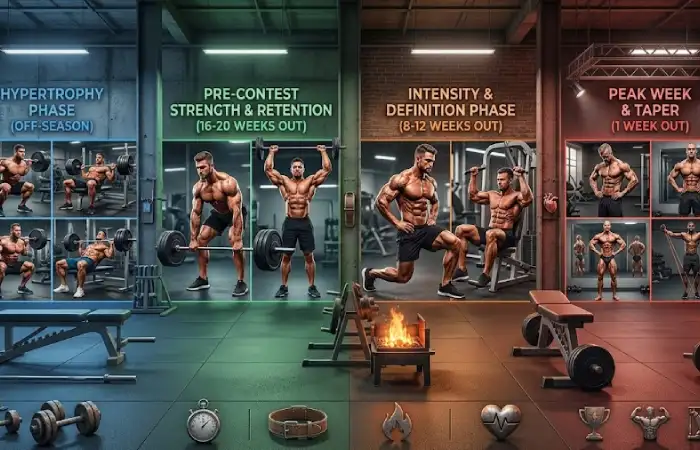
A number of ways to structure your bodybuilding contest-prep training workout. The below are just a few examples. Training splitsCommon workout split types used in contest-prep are as follows:
- Push/pull/legs
- Upper/lower body
- Full body
- Four-day body-part split
- Five- or six-day specialised split
It all depends on how many times you’re capable of doing it each week and your body’s recovery ability.
Example Weekly Structure
| Day | Training |
| Monday | Chest, shoulders and triceps |
| Tuesday | Back and biceps |
| Wednesday | Rest or light cardio |
| Thursday | Legs |
| Friday | Upper body |
| Saturday | Lower body and posing |
| Sunday | Rest |
This is a model instead of a prescribed schedule.
Is It OK to Lift Relatively Heavy while Cutting?
The quick answer is YES. You do not have to drop your resistance training and head to light weights, just because you are on a cut. If the body is still able to recover then lifting relatively heavy resistance training will provide a great stimuli to retain as muscle mass.
It is normal if your strength diminishes over the diet because the individual is in a caloric deficit, fatigued and also at an even lighter body weight. Do not plan on setting new PBs for everything while you are dieting to exhaustion. Keep your form and effort and have at least 0 PBs in something while at a depleted weight.
Should you lift heavy while you’re cutting?
In simple terms. ABSOLUTELY NOT. You don’t have to drop all weight resistance training and do baby weights for each individual movement simply because you are cutting calories.
It’s perfectly acceptable that your strength might decline as the diet progresses because you are eating in an energy deficit, tired, and will be at a lower bodyweight.
Do not set out to PR in anything while dieting to the extreme. Good technique and consistent effort are way more important than setting any strength PBs while exhausted.
Bodybuilding Cutting Workout Plan
It’s essential for your bodybuilding cutting workout plan to also align with your diet program. Fat loss is primarily achieved through correct energy deficit, and the training is essentially to promote muscle retention stimuli, not endlessly increasing amounts of exercise. For your cutting plan:
- Keep resistance training consistent
- Monitor recovery
- Adjust volume when necessary
- Use cardio strategically
- Avoid unnecessary training fatigue
If there’s a significant dip in performance, evaluate recovery, and don’t just add in more workouts.
Cardio in Pre-Contest
Bodybuilding cardio will increase energy output and cardiovascular fitness. Types of activities for this will involve:
- Walking
- Cycling
- Jogging
- Cross-training
- Stair-based exercise
A needed amount depends on each individual A competitive athlete who already is on track with nutrition and resistance training may need very little extra cardio. Another athlete might need additional activity as preparation progresses. Building additional cardio sessions to your weekly routine, on an accelerated schedule may be more manageable than jumping into multiple hours a week.
Pre-contest bodybuilding workout and recuperation
With prolonged dieting recuperation gains significance.
Hence the bodybuilding workout pre-contest should not only take into account:
- Sleep
- Nutrition
- Rest days
- Stress
- Training volume
- Cardio
The signs that you are overtraining can be excessive tiredness, poor performance, low-quality sleep, or the inability to recover between each training session. The competition workload you undertake should be stressful, but it needs to be achievable. The more training, however, doesn’t necessarily mean the more progress.
For evidence-based recommendations on resistance training and exercise programming, the American College of Sports Medicine (ACSM) provides resources for athletes and fitness professionals.
Practice poses on training days.
It is easy to overlook, but practice the required poses for your division from your competition for the duration of your prep weeks. Posing practice builds:
- Stage confidence
- Muscle presentation
- Posture
- Transitions
- Routine consistency
The value of short practice sessions on a regular basis instead of cramming everything in right before competition.
The use of recording practice to identify areas of deficiency.
Peak-Week Workout Plan
Try not to go crazy during peak week with a bunch of experimental movements. A lot of guys (competitors) will cut their volume for the first few days to save themselves for stage, others may take more of a specific approach depending on how they normally are when cutting. There’s no real set in stone for a peak week routine.
Don’t assume that massive amounts of volume are needed in order to look the best on stage, especially leading up to a competition – extra training time can lead to increased fatigue.
Nothing radical needs to happen, and any changes should already be accounted for and not just done randomly when they pop into your head.
Competition training workflow
So a realistic workflow would be:
Build a base—decide competition/division—set training split—start preparation—track performance and amend CV cardio/training as necessary—practice posing—minimize unnecessary exhaustion towards competition—arrive refreshed and with a clean plan in hand.
Key is adjustments based on progress rather than clock-watching without regard to the way your body is adapting.
Realistic Competition Expectations
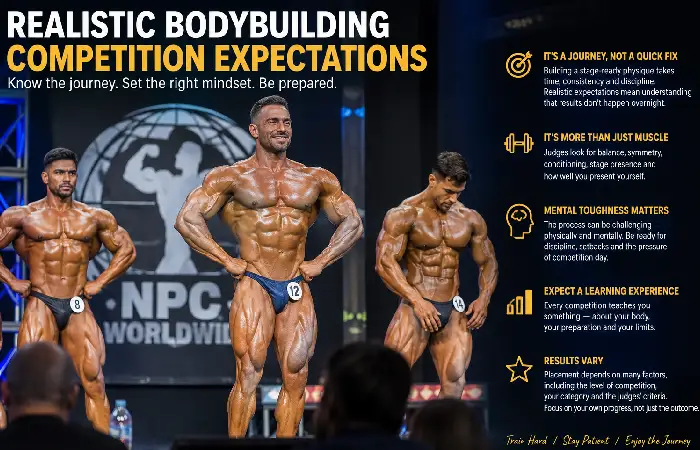
The process of gaining muscle after competition cannot ensure strength gains continue. Many competitors experience within long-term calorie deficit:
- Slower progress
- Reduced training performance
- Greater fatigue
- Reduced recovery capacity
- Increased hunger
This does not mean that the programme is a failure. The aim in the final weeks can turn from increasing new muscle tissue to preserving muscle tissue and reaching your desired condition. Your physique in the end result will also come into account for your own initial amount of muscle, your body’s genetics and how many weeks of preparation you have undertaken, along with nutrition, stage of competition etc.
The most common training errors
- Over-training (as above – extra sessions to over-comeplateau increases fatigue levels but doesn’t cure the reason behind it)
- Chops and changing of training programmes constantly (How will you know if a training programme works if you are changing it every week?)
- Forgetting to incorporate rest and sleep within the training and preparation process (these are as much a part of your training as lifting weights).
- Cardiovascular training in a manner of “punishment”. Cardio needs to fit into a strategic plan for your physique, not a “compensator for poor food choices” or an extra punishment for not eating “correctly”.
- Letting weakest muscle groups fall behind. This is something that needs to be looked at as physique competitions focus not only on mass but proportions too.
- Not practicing posing until late stages of your preparation. Your presentation is every bit as important as your physique.
Your Sample Bodybuilding Competition Workout Plan
Your top body part session for the upper-body:
| Exercise | Purpose |
| Bench press | Chest and pressing strength |
| Row variation | Back development |
| Incline dumbbell press | Upper chest |
| Lat pulldown | Back and lat development |
| Lateral raises | Shoulder development |
| Biceps curl | Biceps |
| Triceps extension | Triceps |
Number of sets, repetitions and training should be customized based on the program, training experience of the athlete etc. Etc This would never replace a individualized medical consultation.
FAQs
What is a bodybuilding competition training program?
It’s a structured resistance-training workout thata competitoruses to build and or maintain the muscles,while undergoing the diet and exercise program needed for a physique competition.
Is my work out going to shift?
Not if you don’t want to. There are competitors who stick with traditional resistance training in the gym but manipulate cardio and or recover times with volume or other cardio changes.
That said volume, recovery and the number of sessions need to make sense relative to the goal.
What should my cardio look like for contest prep?
There isn’t one specific amount- what one person uses varies wildly based on performance.
Training during peak week?
You can, though usually in a much modified form with focus to alleviate fatigue. There isn’t the same workout plan everybody uses on their week #… to compete.
Am I able to add to muscles when competing?
Yes and no depending on training experience, your diet, starting position and condition overall. Competitors most of advanced level only want to make sure they don’t lose their gains. Some beginners in the scene can sometimes add to muscles still.
Conclusion
The purpose of a bodybuilding competition workout program shouldn’t be to work out harder through competition preparation but to enhance the entirety of it. Resistance training as well as suitable cardio training andposing and recoveries all assist in competition preparation. In the beginning, work may be focused on building or retaining muscle, whereas closer to completion, keeping well rested and performing maximally becomes a higher priority. The optimal training program will always vary since everyone has their own physique to reveal, level of experience and fitness, schedule of availability, and ability for recovery.
Bodybuilding Competition Hub
Explore the complete guide to bodybuilding competitions, including categories and divisions, competition preparation, diet plans, workout plans, rules and judging criteria, and posing.