
Best Home Gym Equipment: Complete Buying Guide for Every Space and Budget
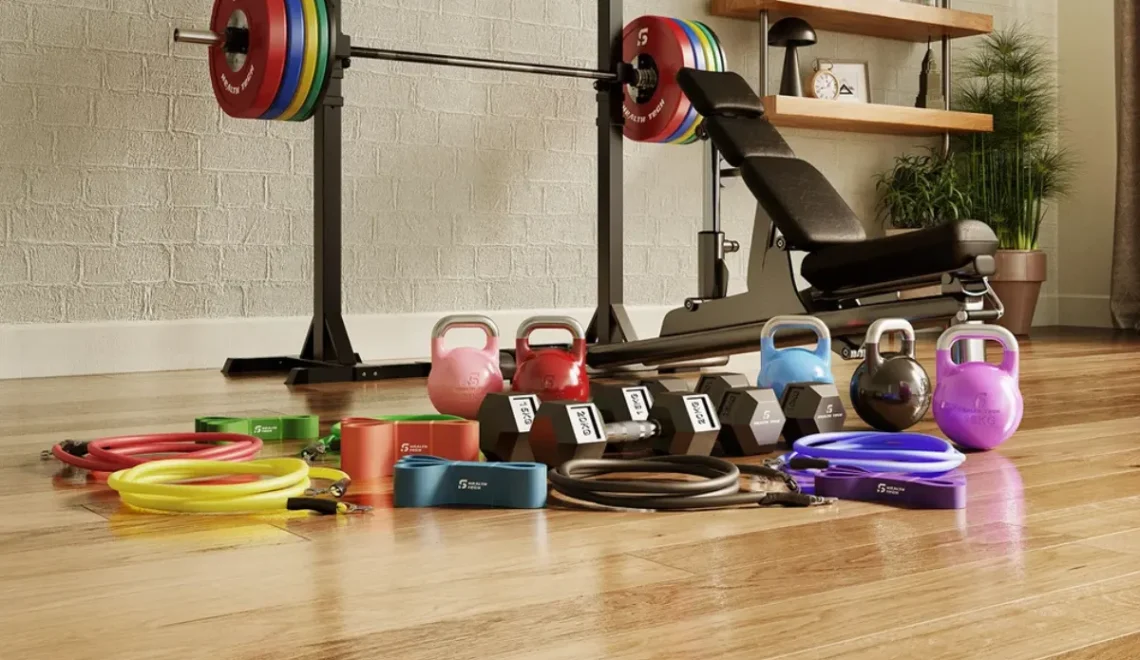
Having a home gym shouldn’t mean you pack the most expensive machine imaginable into your spare bedroom. The best home gym equipment is the equipment you will use most consistently and that effectively targets large movement patterns. For one person, that could be a good set of adjustable dumbbells and a bench; for another, it could be a more minimal exercise bike, a bundle of resistance bands, or some linked strength gear.
You will likely have your favourite equipment depending on your goals, workout space, how much you have to spend, and how many workouts you have logged previously. A new exerciser that’s all about general fitness will be using gear that’s vastly different from the person hoping to build muscle or get stronger .
Here’s everything you need to know about key home equipment types.
This Article Is Part of the Smart Gym Equipment Hub
Explore smart gym equipment, connected fitness technology, features, buying guides, and other useful information in our Smart Gym Equipment Hub.
What is Home Gym Equipment?
Home gym equipment is essentially any exercise equipment that’s intended to be used at home, instead of a public gym. This can range from something as basic as resistance bands, a jump rope or floor exercise mat, to larger equipment such as a treadmill, exercise bike, home multi gym, bench and cable machine.
Modern home gym equipment technologies have enhanced this niche sector with smart devices capable of monitoring data like repetitions and intensity – whether through a smart gym apparatus with built-in sensors or with an integrated app-or by tracking metrics such as duration of workout or heart rate via connected fitness applications.
But not all home exercise equipment need necessarily contain an app or have a futuristic build to be effective. Sometimes a less high-tech machine that actually works with your training regimen makes a good decision.
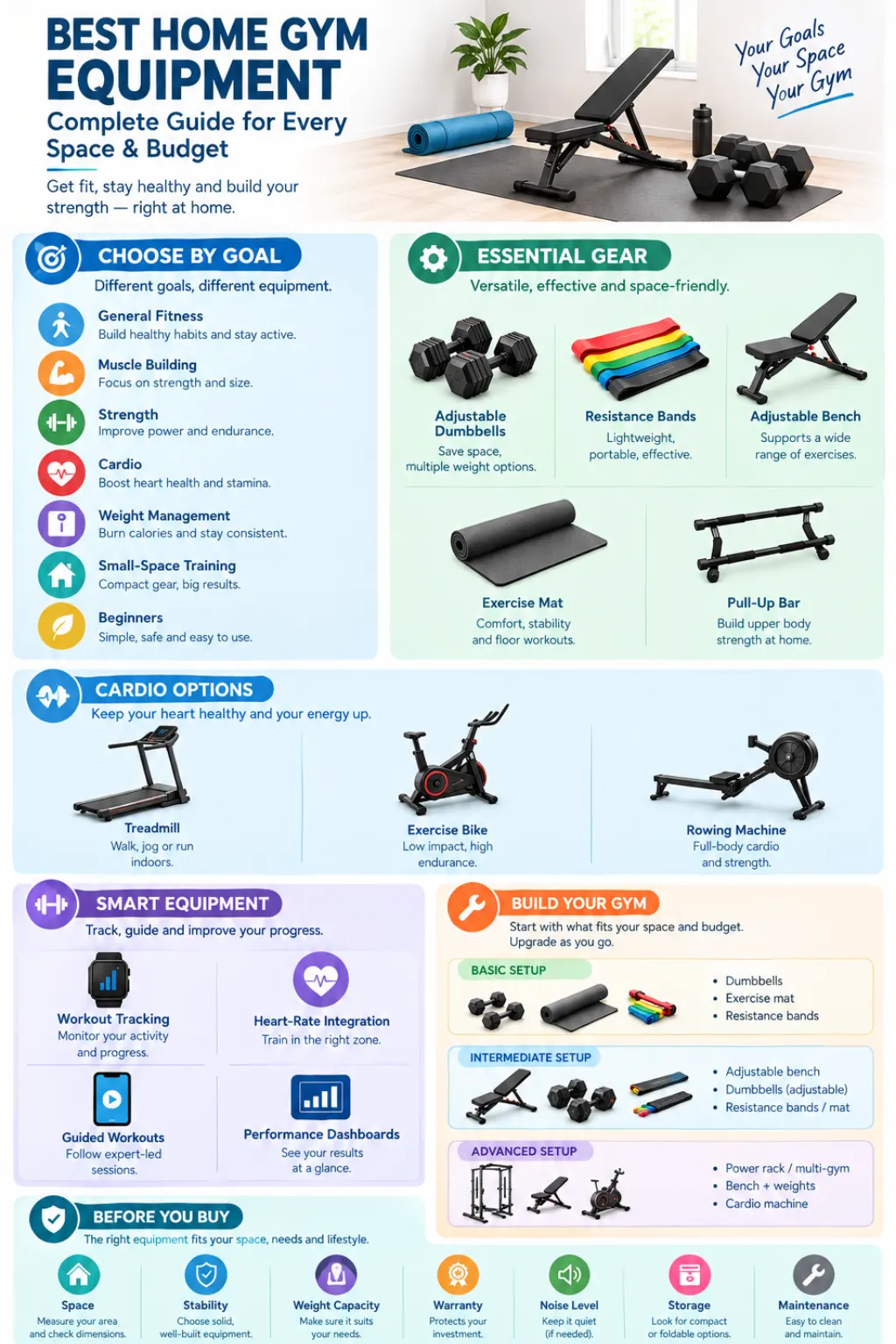
Top home gym equipment for your training goals-
There isn’t really one machine that fits best for everybody so in thinking about buying equipment for a home gym, begin to narrow it down.
| Training goal | Useful equipment | Why it works |
| General fitness | Dumbbells, resistance bands, exercise mat | Covers basic strength and mobility work |
| Muscle building | Adjustable dumbbells, barbell, bench | Allows progressive resistance training |
| Strength | Barbell, rack, plates, bench | Suitable for compound lifting |
| Cardiovascular fitness | Exercise bike, treadmill, rowing machine | Provides structured cardio sessions |
| Weight management | Cardio equipment, weights, bands | Supports both resistance and aerobic training |
| Small-space training | Adjustable dumbbells, bands, mat | Minimal storage requirements |
| Beginners | Bands, light dumbbells, mat | Easy to learn and scale |
| Home workouts with technology | Smart bike, connected trainer or smart strength equipment | Adds tracking and guided workouts |
Use the table to suggest equipment rather than to write a shopping list. The equipment that you choose must complement activity that you can participate in with enjoyment safely.
Must-Have Home Gym Gear You Might Already Own
You Don’t need fancy machines to build a strong fitness setup at home. Even the most petite apartment can easily accommodate a great home gym with just a few key pieces. Here’s how to start:
Flexible Dumbbells
From the space standpoint, flexible dumbbells almost certainly offer you the very best return for your cash you can purchase.
One pair of Flexible Dumbbells effectively eliminates the need for multiple pairs of fixed-weight Dumbbells. They can be utilized for nearly any of the typical Dumbbell movements, including goblet squats, Lunges, Shoulder presses, Chest presses, Rows, Romanian deadlifts (RDLs), Bicep curls, and triceps extensions. Their ability to be swapped out easily allows for quick changes between weight ranges. The trade-offs differ in that some can be adjusted with relative ease while others are cumbersome. Top Picks: Novice, strength workouts, small space home gyms.
Resistance Bands
Resistance bands are cheap, the use for them is varied (strength training to mobility) and you can buy them in numerous different resistances. Bands of varying resistance levels and types, such as loops or tubes with handles, are beneficial for building strength through many of the motions done during Dumbbell workouts, especially for lower body movements.
When comparing to traditional Dumbbells, resistance can vary throughout a movement, and extremely heavy weight is tougher to achieve. Best For: Beginners, travel workout, rehabilitation exercises, space savers.
Adjustable Bench
You can also elevate the training effectiveness with dumbbells. An adjustable workout bench which you are able to recline to different levels, lying flat and so forth will greatly enhance and extend the variety of total body Dumbbell workouts which you’re capable of doing-such as supported exercises, DUMBBELL incline chest, various rows , step up workouts and Dumbbell supported floor press, seating presses. Remember to look out for the total weight capacity, how sturdy, as well as just how smooth adjustment operation is. It’s the most effective for any intermediate to sophisticated physical training program.
Exercise Mat
Whether it’s a thin workout Mat for floor exercises like planks, glute bridges, and ab exercises, or a thicker yoga Mat for mobility and stretching work, there’s always a use for an exercise Mat. Best for: Virtually all home gyms.
Pull-Up Bar
A sturdy pull-up bar is great to train your arms, upper back, chest, and abs – but make sure yours is safely secured to your doorway or a wall before you hang from it.
Best for: Upper body strength and bodyweight training.
Cardiovascular equipment for the home gym
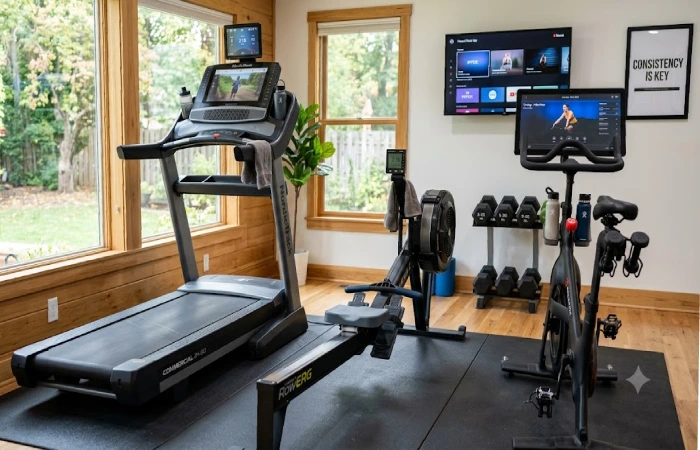
You know that the foundation of a great home gym comes in the form of strength training equipment, however cardiovascular training will complement your workouts no matter the training regime. The equipment you choose will largely depend on what your goals and motivations for training at home are:
Treadmill
A treadmill allows for indoor walking, jogging and running. When the weather is poor or time constraints are an issue, these machines can be the solution to not missing your regular outdoor runs.
However treadmills can also be very bulky and often generate noise and vibration
Check these:
- Dimensions of running surface
- Maximum user weight
- Motor specifications
- Speed range
- Incline facility
- Folding mechanism
- Warranty and ease of service
Noise quality
A treadmill is best only when there is the potential for use to a great extent or the money and the space, is at a greater importance relative to money than it is relative to the floor space; treadmills in general, take up lots of room.
Exercise Bikes
They may need less space than most treadmills, and offer a structured cardio workout. They come in various designs, upright, recumbent and even indoor spinning bikes and some newer, connected versions may also offer preprogrammed training routines, tracking of performance and smartphone integration. This cardio machine is best for people at any level of fitness and are ideal for users with a limited amount of floor space and/or for users seeking an indoor low-impact workout.
Rowing Machine
Rowing machines can work the full body at the same time while the workout they provide gives excellent cardio results.
Compared to home use the main issue with rowing machines is storage, usually they are quite long although many can be stored in a vertical position when they are not being used.
Good for everyone, including people who like rowing or want to get a total body cardio workout and improve posture.
Smart Home Gym Equipment – Should You Buy It?
Smart home gym equipment places some tech into traditional exercise equipment. This can take the form of
- Bluetooth connectivity
- Wi-Fi
- Workout tracking
- Repetition counting
- Heart-rate integration
- Training history
- Digital resistance adjustment
- Coaching or guided workouts
- Smartphone applications
- Performance dashboards
Instead of “is this machine intelligent,” the right question to ask is, “does it have a utility for me?” Someone who loves data tracking related to working out may enjoy using a connected machine; someone who just wants three weekly days of strength workout does not necessarily need an internet-enabled machine.
Smart equipment can be useful when:
- You enjoy structured workouts.
- You want training data in one place.
- You prefer guided sessions.
- You like monitoring progress.
- You regularly use fitness apps.
It may not be worthwhile when:
- You prefer independent workouts.
- You are working with a tight budget.
- The equipment requires an expensive subscription.
- You already have a training system that works.
- You are unlikely to use the connected features.
Checking the specifications of products before you make a purchase:
All the numbers that seem to make the specification a really impressive read may not be as important to you as it makes them look.
| Specification | Why it matters |
| Maximum user weight | Indicates the intended load capacity |
| Weight range | Important for progressive resistance training |
| Dimensions | Determines whether the equipment fits your room |
| Folded dimensions | Useful for equipment that needs storage |
| Product weight | Affects stability and portability |
| Resistance mechanism | Determines how resistance is produced |
| Connectivity | Relevant to smart features and apps |
| Display | Shows workout metrics on supported products |
| Power requirements | Important for powered equipment |
| Warranty | Provides information about manufacturer support |
| Replacement parts | Important for long-term ownership |
| Noise level | Particularly relevant in flats and shared homes |
Don’t get too hung up on max specs-just because a machine has massive resistance range doesn’t mean it’s going to be effective if the thing is rickety, uncomfortable or a nightmare to adjust!
Step-by-step: how to build a home gym
You don’t have to buy it all at once
Step 1: Set your main purpose
First, identify the primary reason why you are building a home gym. Do you want to:
- Increase strength
- Improve muscle mass
- Increase cardiovascular fitness
- Enhance general health
- Make exercise more convenient
- Be able to do workouts at home
- Complement other sports
Step 2: Measure your available space
Take a good measurement of both the room itself, and also the space you require when exercising. The space the equipment occupies when not in use is often different to when it is in active use; a bench may fit right up to the wall, but you will need substantially more space to do Bench Press.
Consider how you might use doors and windows, flooring and ceiling height.
Step 3: Start with multipurpose equipment
Your best bet when setting out is to opt for equipment that can be used for multiple different exercises, e.g. An adjustable set of dumb bells offers range for the entire upper and lower body compared to single dumbbells that have limited use.
Step 4: Layer in equipment as needed based on how you train
Once you know which exercise activities are your “go-to” or most frequently practiced, choose equipment that fills these needs. A small home gym could be perfectly comprised of: dumbbells – weight bench – resistance bands – cardio equipment, rather than filling your space with multiple large machines.
Step 5: Include tech and smart equipment were useful.
Technology can be a great facilitator, but your primary focus should remain on what enables effective training.
If technology in the form of monitoring your activity is important for you and keeps you motivated and committed, you may consider smart training equipment.
Equipment Performance: How Much Can I Learn at Home?
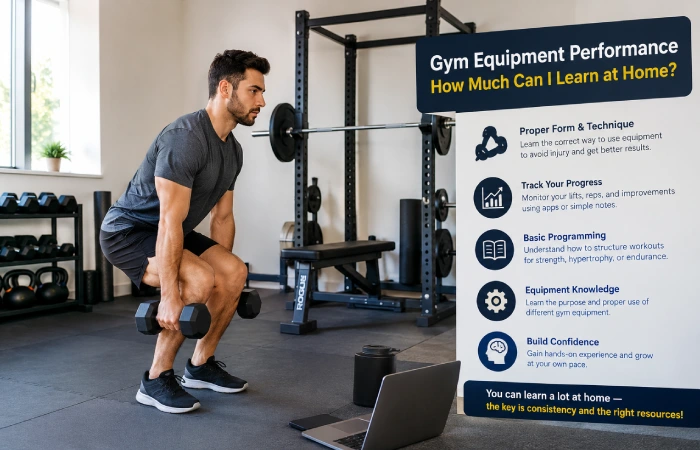
Although a home gym enables for productive training, nothing but the actual equipment does not lead you to accomplishment. Among other elements: Progress relies on:
- Training consistency
- Exercise technique
- Appropriate resistance
- Progressive overload
- Recovery
- Sleep
- Nutrition
- Individual training goals
A pair of flexible dumbbells could easily support a serious weight training program and another competitor striving to powerlift seriously, will need something that will take far heavier loads. Again, a treadmill can make for some decent exercise without owning a treadmill is the guarantee of fitness
Expensive Home Gym Equipment vs Cheap Home Gym Equipment
You don’t always need to break the bank to build yourself a practical home gym.
Affordable options
- Exercise mat
- Resistance bands
- Skipping rope
- Basic dumbbells
- Doorway pull-up bar
- Adjustable kettlebell
These products can provide a strong foundation for beginners.
Mid-range options
- Flexible Dumbbells
- Adjustable bench
- Exercise bike
- Compact cable system
- Better-quality kettlebells
- Folding cardio equipment
Higher-cost options
- Power racks
- Olympic barbells and plates
- Commercial-style cable machines
- Connected strength systems
- Premium treadmills
- Smart cardio machines
If you’re spending more money, you may get better build quality, custom settings, or more advanced technology, and these features should offer enough of an improvement to your training routine.
Pros and Cons of a Home Gym
Pros
- No commuting to a commercial gym
- Training can fit around your schedule
- Equipment is available whenever you need it
- Greater privacy
- No monthly gym membership is necessarily required
- Can be customised around your goals
- Useful for short workouts
Cons
- Initial equipment costs can be high
- Equipment takes up space
- Large machines can be difficult to move
- Maintenance may be required
- There may be fewer training options than at a large gym
- Motivation can be harder for some people
- Heavy equipment can create flooring and noise concerns
So a home gym isn’t necessarily cheapest or best when compared to a gym. It’s greatest plus is convenience and control.
Who Should Buy Home Gym Equipment?
Home equipment can be a good choice for people who:
- Prefer exercising at home.
- Have limited time for travelling to a gym.
- Want to train outside traditional gym hours.
- Have sufficient space.
- Already know which types of exercise they enjoy.
- Want to create a personalized training environment.
It can also be useful for experienced gym users who want additional training options at home.
Who Should Avoid Buying Large Equipment?
Think carefully before purchasing large machines if:
- You have not established a regular exercise habit.
- You have very limited floor space.
- You are unsure whether you enjoy the activity.
- You are buying equipment mainly because it is heavily advertised.
- You cannot safely install or operate the equipment.
- You have significant concerns about noise in a shared building.
Investing in some basic but flexible equipment can be a better idea in the first instance.
Are Home Exercise Machines Safe and Valid?
A home workout program is authentic, but the level of merchandise depends on the maker and mannequin. In earlier than you purchase, explore:
- Manufacturer information
- Independent product reviews
- Warranty terms
- Weight limits
- Safety instructions
- Replacement parts
- Customer support
- Electrical certification where relevant
- Return policies
And if you use powered machinery, never underestimate electrical safety. On the other hand, with free weights, resistance machines and other equipment, check the equipment for cracks, poor connections, fraying of cables, etc. An item of equipment has clear instructions rather than relying only on exaggerated descriptions of its merits.
Home Gym Equipment vs a Commercial Gym
| Factor | Home gym | Commercial gym |
| Convenience | Very high | Requires travel |
| Equipment variety | Depends on your setup | Usually extensive |
| Upfront cost | Can be high | Usually lower initially |
| Ongoing membership | Not required | Usually required |
| Privacy | High | Lower |
| Space | Limited by your home | Usually greater |
| Heavy equipment | Limited by space and budget | Generally easier |
| Social environment | Limited | More opportunities |
| Training flexibility | Very high | Depends on opening hours |
| Smart technology | Optional | Depends on facility |
There’s no “best one.” If you have access to loads of machines, heavy weights or want to exercise with a friend, a public gym is the better choice. If convenience and a more private space are important to you, then a home gym should be ideal.
Choosing home exercise equipment
Before adding to your cart, take into account the following.
1. Will it ever get a look-in?
This is number one, two and three.
Equipment that enhances an activity you love is often more worthwhile than complex technical equipment that won’t get used.
2. Will the thing actually fit where i want to put it?
Don’t check the size of the product in its box, but rather its fully assembled size and proportions. With regard to equipment that involves moving parts, consider how much ‘operating space’ you need – not just the static size of the product.
3. Can i grow with it?
While most beginners require only low levels of resistance from certain equipment types, increased strength and ability might require more resistance options or a more advanced piece of kit altogether.
4. Does the thing look stable?
Important for things such as benches, racks, and pull up bar for instance where there’s either movement or weight being lifted.
5. What’s in a warranty?
Not only length, but which parts/components are covered and whether the service package includes replacement parts and labour.
6. Does my smart gadget come with fees to access its features?
Some online fitness products come without subscription charges for core exercises but have fee paying additional modules/features added over the lifetime of the device.
Consider the cost over a couple of years as well as the upfront cost.
7. Where would i even find spare parts?
This applies primarily to equipment such as machines that feature cables and/or electronics and other devices where there are moving, especially, propriety parts.
Smart Ways to Set up a Functional Home Gym in Any Price Range
Basic Setup
A beginner could start with:
- Exercise mat
- Resistance bands
- One set of dumbbells
- Skipping rope
This combination requires little space and can support basic full-body workouts.
Intermediate Setup
A more comprehensive setup could include:
- Flexible Dumbbells
- Adjustable bench
- Resistance bands
- Pull-up bar
- Kettlebell
- Exercise bike
This provides a broader range of resistance and cardiovascular training.
Advanced Setup
An experienced strength trainee might consider:
- Power rack
- Olympic barbell
- Weight plates
- Adjustable bench
- Dumbbells
- Cable or pulley system
- Dedicated storage
- Flooring suitable for the equipment
This setup requires substantially more space and attention to safety.
How to Pick the Best Home Gym Gear for a Tiny Place
If you reside in a studio flat, mini dwelling house, or house share, concentrate on pieces of kit this are easy to shop for away when yous’re not using them.
Solid small-space options
– Flexible Dumbbells Instead of a variety of fixed weight pairs
– Resistance bands Stow neatly in a drawer
– Fold-up bench Less storage space needed when tucked away
– Small exercise bike Usually fits in better than a treadmiill
– Kettlebell A single bell can work for many moves
– Exercise mat Rolled away when done
– Don’t buying big equipment on account of the fact y ou’ve got a lone unoccupied nook in your house.
Constantly think ofhow your training equipment is going to impact the remainder of the dwelling when it’s in usage.
Common Home Gym Building Mistakes
Purchasing equipment before working out: A successful routine doesn’t always require a room of gym equipment; you can exercise effectively with as little as one piece.
Sticking to a budget: Don’t always go with the cheapest product; not only is a budget option less likely to last, but it may not be easily adjustable to your body type.
Getting a machine with max specifications: A machine’s highest resistance, largest display, or best speed capabilities may be incredibly desirable; they, however rarely impact what will be used for workouts.
Overlooking storage needs: If your home gym will be in a living area or other frequented part of your house; workout equipment will create obstacles.
Neglecting maintenance: Moving parts may collect dirt, cables may become frayed, and electronics could require maintenance.
Too much technology: Technology like touch screens and integrated computers are helpful, but unless they are providing a real fitness solution; there’s no reason for them.
Alternatives to Classic Home Gym Equipment
Good news: You don’t need a full set of machinery to shape up.
- Bodyweight training exercises (push-ups, lunges, squats, planks) demand little or no equipment
- Outdoor activity (walking, running and biking are a nice pairing for a smaller home gym)
- Resistance bands: These are great in that they allow for a versatile variety of workouts and don’t need to be put away after use.
- Adjustable equipment: Instead of buying a distinct piece of equipment for each type of workout, you can opt for some adjustable items that save you money and storage space.
For many people just starting out a fitness regime, these options are a great starting point on the way toward investing in more expensive equipment.
FAQs
What equipment should all home gyms include?
There is no set list to include; exercise mat and at least one form of resistance are a good starting point. Weights, resistance bands, or kettlebells work for a huge array of exercises and don’t take up too much space.
Is a home gym more affordable to install?
A home gym has the potential to be cheaper over time – the cost ultimately depends on the accessories you select. A straightforward home gym does not need to be very costly, but an arsenal of racks, barbells, plates, and exercise equipment for workouts will end up being costly.
Do smart equipment for home gym merit acquisition?
If you consider workout tracking, workout programs that use connected apps or instruction as important, this smart home gym equipment is a solid investment. Otherwise, you have a range of choices that do not include smart functionality.
What is the best home gym equipment for weight loss?
It’s not the specific piece of equipment, but an exercise in itself, along with cardiovascular exercise and eating patterns, and one in which you’ll do consistently, which will help with your weight.
Can you build muscle with home gym equipment?
Yes. Resistance training with weights, bands, kettlebells, and a variety of home workout equipment can provide support to promote muscle building when workouts have the adequate challenge over time and intensity.
How big a space for a home gym is required?
Your equipment will determine this — in most cases, you might be ok with just two to four square feet to begin your home gym, or even less! In others, the equipment such as a squat rack, Olympic barbell, and bench alone can take up considerable room. Don’t just measure the dimensions of your equipment, but also the equipment along with any swinging weight bars or areas needed to safely perform any exercise movements you plan.
Should I purchase a treadmill or a stationary exercise bike?
It all depends on how you do cardio, the dimensions that are needed to provide for a stationary exercise bike, as well as a walking machine/treadmill. An exercise bike is generally a smaller option than a stationary walking machine, and an effective cardio machine.
Final Thoughts
When building your home gym, don’t fall into the trap of assuming the biggest, most expensive and highest-tech equipment will be the best. The right kit for you will depend on your training space, targets, budget and the ability to make training with it a habit. However, for a lot of you, a decent pair of adjustable resistance bands, a yoga mat, and a sturdy bench, could be a sensible first choice.
After that, cardio equipment choice can be a matter of taste, and smart kit should be seen more as a bonus than essential.
Slowly add to your collection: start with the gear that tackles your most significant training gap, use it regularly, and don’t expand until you can genuinely add value. This is a far more sustainable way to create your perfect home gym than buying an entire warehouse of gear on day one.
Best Home Gym Equipment Hub
Explore the complete guide to the best home gym equipment, including options for beginners, small spaces, budget-friendly setups, smart equipment, strength training, and all-in-one machines.