
Bodybuilding Competition Categories and Divisions: Complete Guide
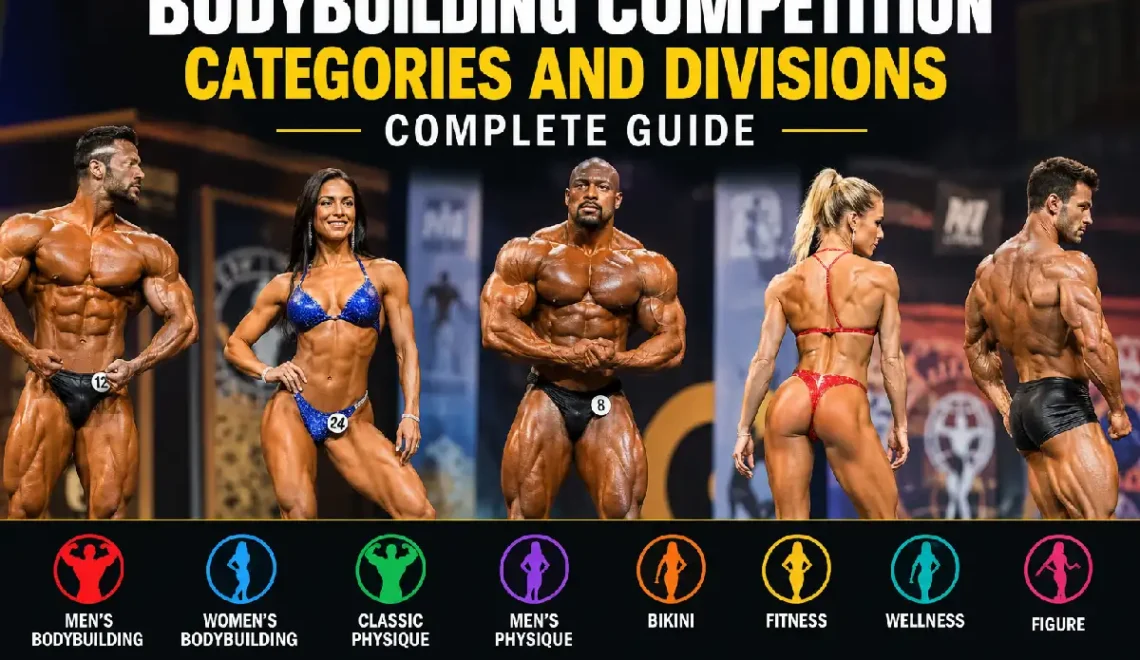
Choosing the category to enter will be one of your most significant decisions when entering a bodybuilding show. There is several reasons why categories are separated in bodybuilding – mainly to make for more consistent judging within each category by standardisation as far as type of physique/contest requirement by a category will allow. The categories for the show will vary somewhat depending between individual organisations and shows: -Some are more for pure size and mass, while others reward conditioning, proportion, symmetry, presentation.
Know this, and you may see where you best fit in.
Please note: Rules do vary between organisations – check with your federation’s latest show rules before competing.
This Article Is Part of the Bodybuilding Competitions Hub
Explore bodybuilding competitions, categories, preparation, diet plans, workout plans, rules, judging criteria, posing guides, and other useful information in our Bodybuilding Competitions Hub.
Bodybuilding Divisions
These are ways to group similar types of competitors against one another based on common judgments. The criteria that define the bodybuilding divisions can range from:
- Sex
- Age
- Height
- Weight
- Experience level
- Physique style
You want to establish a more suitable comparison between individuals. A particular event does not have all divisions/categories available. Smaller local events will probably lack divisions and categories compared to a major national or international tournament.
Main Bodybuilding Categories
There is a variety of common types of bodybuilding competition namely; traditional bodybuilding, classic physique, men’s physique, women’s bodybuilding, women’s physique, figure and bikini. These divisions have different judging standards and posing routines.
Men’s Bodybuilding
Men’s Bodybuilding is typically judged on significant muscularity, symmetry, proportion and conditioning. Competitors will execute several different required poses that the judges will use to compare muscle groups to each other. This is usually best suited for individuals whose main physique attribute is that of overall maximal muscularity.
Classic Physique
Classic physique tends to emphasize the look of the classic, proportional and proportioned muscle group, balancing proportions and presentation over sheer musculature. Some federations will have weight limits based on height, so consult the rules of the relevant federations as that often plays a role.
Men’s Physique
The standard for men’s physique differs drastically from traditional and classic bodybuilding. Athletes typically wear board shorts, with a standard that judges a competitor based upon; proportions, muscularity, conditioning, symmetry and presentation. This can often allow for slightly less musculature.
Women’s Physique Categories
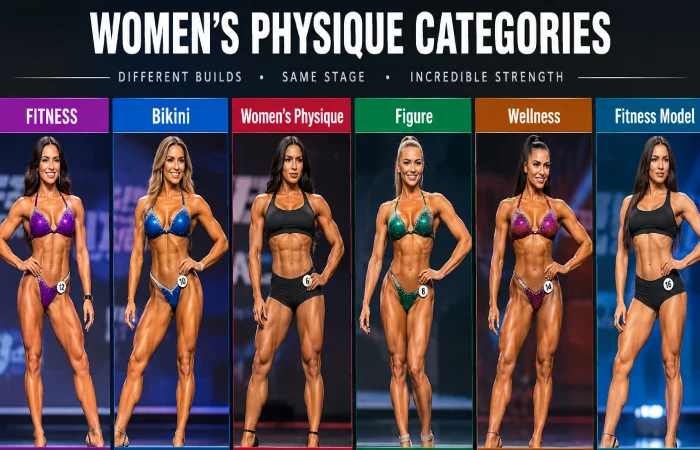
Depending on the federation women can compete in one of a number of physique categories:
Women’s Bodybuilding
Women’s bodybuilding can and is primarily centred on a physique that is muscular developed, well proportioned and perfectly conditioned. This is the intended category for athletes of muscular development who display confidence showing off their muscular physique through bodybuilding posing.
Women’s Physique
Women’s physique places and typically demands a muscled standard between women’s bodybuilding and lesser muscled physiques categories. Standards used in judging vary but usually on such points as muscular development, conditioning, proportions and symmetries, presentation.
Figure
Figure overall requires an overall appearance and condition, with a greater focus on symmetries and proportions and muscular development while maintaining a feminine physique and generally not of a muscled size that demands women’s bodybuilding.
Bikini
One of the most renowned women’s physique categories the division requires:
The overall shape and conditioning of physique
balanced proportions
The overall physique condition, presentation, stage presence, while still demands muscle of women’s bodybuilding that has been appropriately conditioned.
Weight classes for bodybuilding
In bodybuilding competitions some use weight classifications with competitors divided according to body weight. Take a specific show for an example; there might be several classes with the bodybuilding competitors being split up so they only compete against other athletes in the same approximate weight range.
Note that weight classifications aren’t a norm.
- Weight classes
- Height classes
- Height to weight limits
- Open categories
Age classes are all used by some shows. Therefore always make sure that these classifications are the same for each contest you enter.
How To Choose The Perfect Bodybuilding Division
Don’t just look for the most popular category when picking your bodybuilding division – instead, look to consider:
- Your physique and shape: This is how you look, specifically at your conditioning, muscle growth and proportions.
- Your specific competition goals: Do you want to become as muscular as possible (possibly to compete as a larger heavyweight), or do you aim for a leaner, more toned look for a lighter division?
- The federation’s official standards: There’s no point in applying for a division you simply do not meet.
- Your posing style: Some divisions have specific posing rules and preferences, which you must learn before stepping onto the stage.
- Your coach or an experienced competitor: You could ask a bodybuilding coach if you are undecided what competition division you’d rather have!
The International Federation of Bodybuilding and Fitness (IFBB) provides official information on bodybuilding divisions, competition rules, and athlete categories.
Bodybuilding Categories Comparison
| Division | Main emphasis | Typical presentation |
| Men’s Bodybuilding | Muscularity, symmetry, proportion and conditioning | Mandatory bodybuilding poses |
| Classic Physique | Muscularity, aesthetics and proportion | Posing trunks and bodybuilding-style poses |
| Men’s Physique | Shape, proportion and presentation | Board shorts |
| Women’s Bodybuilding | Muscular development and conditioning | Bodybuilding poses |
| Women’s Physique | Muscularity, symmetry and proportion | Physique posing |
| Figure | Symmetry, proportion and muscular development | Figure posing |
| Bikini | Shape, balance and presentation | Bikini posing |
These are broad descriptions. The exact standards depend on the event and federation.
A newbie to competition
Here’s some things you should consider before jumping in: First-timers: Don’t base your choice on a picture of a pro’s physique. A competitive physique on the highest level took years to attain, usually requiring a specific training and diet plan.
A first-timer needs to understand the criteria, and evaluate if that stage is suited to his physique.
Judge’s are also relative; not only must your physique match the stage requirement, but quality relative to others competing that day may vary. View your first contest experience less as “how good is my physique” and more as an excellent learning experience.
FAQs
Are there divisions in bodybuilding shows?
The divisions that classify contestants by specific measurements or physique type are bodybuilding categories. Categories vary as follows physique type, gender, age, weight, or height.
What are common bodybuilding divisions?
That are some typical divisions for men in bodybuilding contests bodybuilding , classsic physique, men’s physique; for women is woman’s bodybuilding, women’s physique, figure and Bikini. This also change from a competition to other, although the most know are this one that i quoted in above.
Are the bodybuilding weight classes used in every single competition?
No. In fact some competitions are called weight class contests, others are height classes, height to weight limits, open, or other specific division.
Which is the division best suited for beginners bodybuilding competitions?
There is no best suited division for beginners overall. Depending on the contestants body type, competition, and the governing federations rule Book.
Conclusion
Before competing, knowing the different bodybuilding categories that are on offer is the most important part of planning ahead. Men’s bodybuilding, classic physique, men’s physique, women’s bodybuilding, women’s physique, figure and bikini all differ greatly between each other in regard to expectations on the level of musculature, presentation style, condition and overall physique.
However instead of simply following what looks best or which category tends to be the most popular, first consider the official criteria to get a clear vision of which category suits your current physique.
Seeking professional advice from an experienced coach as well as rehearsing poses is beneficial if this is your first time competing as well.
But in most cases ensure you check the exact rules of the specific contest that you would like to enter as competition standards can change from show to show!
Bodybuilding Competition Hub
Explore the complete guide to bodybuilding competitions, including categories and divisions, competition preparation, diet plans, workout plans, rules and judging criteria, and posing.