
Bodybuilding Competition: Complete Guide to Preparation, Diet, Posing and Rules
A bodybuilding contest involves much more than just filling out with a lot of muscles. Competitors have their physique in peak condition after many months spent undergoing resistive training, proper nutrition, recovery practices, and learning and practicing their routines. The judges evaluate how well an individual is able to show off their muscular development, condition, proportion, and their entire stage presence at that particular competition.
The idea of training for the first bodybuilding competition can feel confusing. The various divisions, federation rules, and expectations around diet and posing, along with various strategies to approach. Here is a breakdown of competitive bodybuilding, the kind of preparation involved,, and what you can expect out of your first competition.
In terms of preparing for a bodybuilding competition, there can be significant diet restrictions, major body weight changes, and serious amounts of physical output. Some procedures, like severe dieting, lack of fluids, can even be dangerous. It is always best to talk to a doctor and a reputable trainer to assess whether or not competing is right for you.
This Article Is Part of the Bodybuilding Competitions Hub
Explore bodybuilding competitions, categories, preparation, diet plans, workout plans, rules, judging criteria, posing guides, and other useful information in our Bodybuilding Competitions Hub.
What is a bodybuilding competition?
A bodybuilding competition is a physique event that’s evaluated by a judging panel. Instead of evaluating performance on speed, time, or force, a competitor’s physique characteristics are assessed. In accordance with the Federation and the discipline/type of competition, the judges may decide that the competitor’s…
- Muscular development
- Muscle symmetry
- Proportion
- Definition and conditioning
- Presentation
- Posing
- Stage presence
- Overall balance of the physique
Each organization uses the scoring system slightly differently. Some have divisions or competitions set up on standards relating to different physique styles. This differentiation is quite crucial since competitive bodybuilding is not a show that determines which competitors have the biggest muscle.
A competitor with plenty of muscle may lose against one who measures up to the division’s profile more readily, even though, or simply due to the measurements of their physiques.
What is a bodybuilding contest?
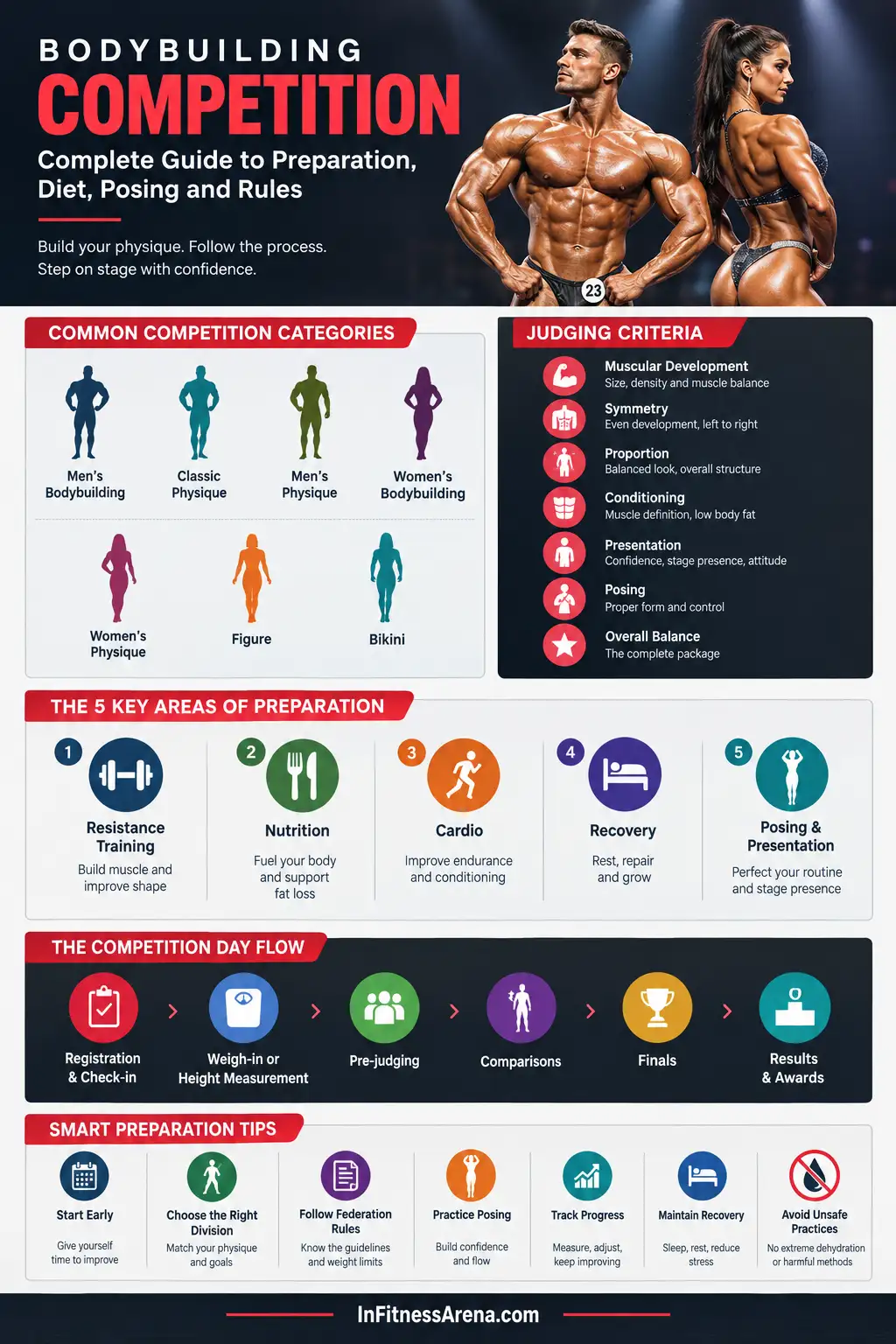
Although there is a variety of event structures, in general they follow a similar format:
- Registration and check-in Participants arrive and register themselves with the organizers and hand over proof of identity, membership card, or membership certificates.
- Weigh-in or height measurement Depending on the category, there are different categories using height classes or weight groups. This may include taking measurements or checking weights of the athletes.
- Pre-judging The athletes will present themselves on stage to the judges and display the required poses.
- The judges compare the athletes in the same group.
- Comparisons: They may be asked to show comparative poses with multiple athletes so differences in terms of muscular structure, symmetry, presentation, or training progress can be better observed.
- Finals: The athletes compete again on stage for their final poses, routines, or presentations, depending on the kind of show.
- Results and awards According to the determined placements, the winners are announced.
However, the relevant federations and show organizers do always provide their specific guidelines.
Understanding Bodybuilding Competition Categories
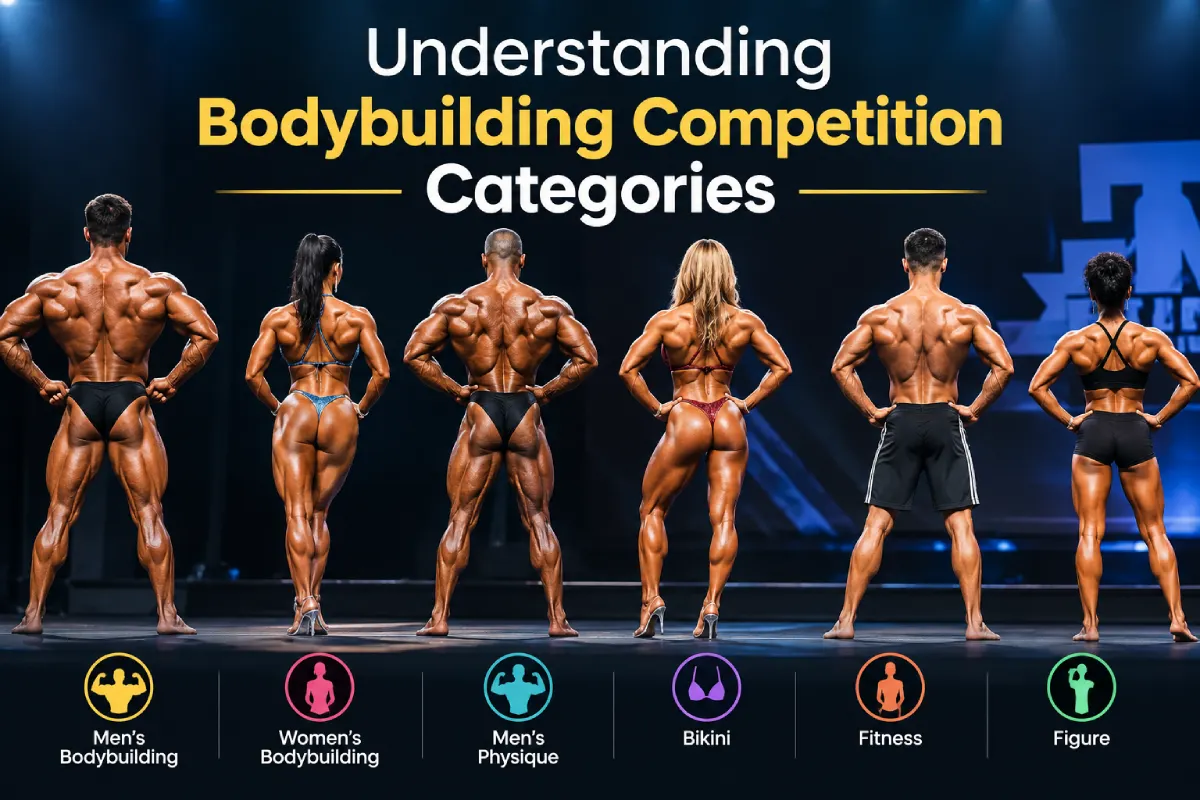
When embarking on bodybuilding competitions, one of the initial challenges a new competitor faces is finding the right category.
Men’s Bodybuilding
This category of male competition is typically seen as a competition for the total muscular development of a bodybuilder. Proportionality and muscle balance are critical elements. Competitors will generally do a series of mandatory posing that the judges will use to compare one part of the physique to the next.
Classic Physique
This area of male competition is different to what the name of the standard bodybuilding competition suggests in that it has a desire to balance the aesthetic proportions of a physique that have perhaps taken a step back from the overall, huge mass of the modern day bodybuilding scene. Weight to height ratio should also taken into consideration by competitors.
Men’s Physique
Men’s physique requires competitors wear a board short, the emphasis being on the development, shape and projection of parts of the body according to the category’s federation federation guidelines.
Women’s Bodybuilding
Women’s bodybuilding competitors are judged on symmetry and muscle conditioning but a different set of physical parameters than the women’s divisions.
Women’s Physique
This can loosely be described as the area between women’s bodybuilding and the women’s divisions that emphasize a more moderate level of musculature depending on the federation.
Figure
This area of female competition often places strong importance on symmetry, balance and projection of a more developed shape of the muscular structure together with conditioning.
Bikini
The criteria for bikini competitions largely rely on presenting an athletic shape that relies on proportions and physique development in a balanced context in relation to other competitors of either sex.
Always refer to the most up-to-date regulations that pertain to your federative and compete according to the strict criteria that come under each division category.
Bodybuilding Judging: What do the judges see?
Before we consider prep, we really should examine what judges are looking for in a bodybuilding pose.
Muscular development
The judges take into account the size and the maturity of the muscles, which are relevant to the division.
This does not just mean having the maximum muscle mass. The development must meet the criteria for the category.
Symmetry
Symmetry refers to the degree to which the body is equally developed from side to side and from upper to lower.
For instance, a considerable imbalance in development of a side may play a role in the overall evaluation of a competitor.
Proportion
The proportion is the relative size of various muscle groups.
Sometimes, a competitor has some great individual body parts, but can lack balance overall.
Conditioning
Conditioning-muscles, definition and visibility. To point out is the amount of fatigue, which is needed on different divisions.
Presentation
Even two athletes with similar build can come across very differently depending on their posing, posture, transitions, confidence, stage presence etc.
This is why bodybuilding posing should be taken seriously during training.
According to the IFBB Pro League, bodybuilding competitions are divided into different divisions, each with its own judging criteria and requirements.
Bodybuilding competition training: the preparation—how do you start?
A bodybuilding competition preparation normally lasts months, no weeks. It relies on how healthy an athlete is at the moment, with their background history in coaching, and which division they want to aspire to. The sensible preparation process typically consists of 5 segments:
- Resistance training
- Nutrition
- Cardiovascular activity
- Recovery
- Posing and presentation
Assess your starting point
Before setting a competition date, consider:
- Current body composition
- Training experience
- Muscle development
- Previous dieting experience
- Recovery capacity
- Work and family commitments
- Ability to follow a structured nutrition plan
- Competition requirements
In an attempt not to arrive at the point of being in stage condition in as short space as it possible, it is far better to take a realistic period of time.
Construction of a competition training program—Contests
Resistance training forms the core of contest preparation. The goal should be to maintain or gain muscle tissue while shedding bodyfat where applicable by designing training around this element and reducing caloric intake. Common training programmes take a variety of forms:
- Push/pull/legs
- Upper/lower body
- Body-part splits
- Full-body training
- Hybrid programs
There’s no split which is guaranteed to always give a superior result.
Prioritize good training
Your training does not have to completely overhaul every few weeks during the competition phase.
Useful priorities include:
- Maintaining good technique
- Training muscles through appropriate ranges of motion
- Managing training volume
- Monitoring fatigue
- Maintaining sufficient recovery
- Adjusting training when performance or recovery deteriorates
More training isn’t necessarily better. “If you dramatically increase training load but at the same time decrease your intake on food and sleep, you’re going to build up a tremendous amount of fatigue quickly,” says Gualtieri.
Cardio for Your Pre-Competition Workout
You may incorporate exercise in the form of cardio training as a way to boost caloric expenditure and to maintain your cardiovascular health. Cardio training exercise options might include:
- Walking
- Cycling
- Jogging
- Cross-training
- Stair-based exercise
How much the ‘right’ cardio is, will be relative to you. Excessive cardio starting off, simply because you have a race pending can hinder recovery more than make a difference. Slow and steady can be kinder!
What constitutes a bodybuilding competition diet?
Typically, a bodybuilding competition diet will focus on managing overall energy consumption but ensure that adequate amounts of protein and nutrients are being consumed to maintain muscle during training.
A typical plan may contain:
- Protein-rich foods
- Carbohydrate sources
- Dietary fats
- Vegetables and fruit
- Adequate fluids
- Appropriate micronutrient sources
The foods may consist of any lean meats, fish, eggs, dairy products, beans or other legumes, whole or refined grains, potatoes and rice, vegetables, fruit, nuts, and any other whole or naturally processed foods.
The specific amount of each macronutrient will be individual.
Protein: The needs of dietary protein will be raised throughout a reduction phase; usually an objective of weight loss with minimal lean muscle mass gain will be necessary.
Carbohydrates: Dietary carbohydrates are utilized as training fuel. Restricting the amount of carbohydrate taken will make intense training difficult some competitors.
Dietary fats: Dietary fat can contribute to physiological functioning and overall diet quality.
Rather than cutting out the food groups altogether where there is no indication they are detrimental to diet, a competition should construct a diet that they are prepared to adhere to long-term.
Example Practical Competition Diet
A single day might be comprised of the following.
Foods, for example, meals
- Breakfast—eggs, oats, and fruit
- Lunch—Chicken, rice, and vegetables
- Pre-workout—Yogurt, fruit, or another source of carbohydrates
- Dinner—Fish or lean meat and potatoes and vegetables
- Snack—Greek-style yogurt, cottage cheese, or another food with high content of protein.
This is a template competition diet ONLY, NOT individually personalized to a competitor. Calorie and macronutrient needs are going to be individual as well (body size, activity, demands of the contest, and phase).
The Role of Supplements
Supplements are no alternative to sound eating.
Various products are taken depending on the individual as follows.
- Protein powder
- Creatine
- Caffeine
- Basic vitamin or mineral supplements when dietary intake warrants them
However, supplements are often a matter of individual use, especially in cases of medication or illness use. For competitive athletes, remember it is possible that a product can be laced with undeclared and contaminated substances. If you fall into the parameters of the drug-tested category, you need to give your third-party testing certification and federation standards some due consideration before use.
Bodybuilding Posing & The Practice Aspect
Of the easiest parts of contestant preparation one must underestimate is the practicing poses. There is no way one will know what an athletes physique looks like properly unless you are given continued show to demonstrate the musculature on display.
Posing practice may include:
- Mandatory poses
- Transitions
- Quarter turns where applicable
- Individual routines
- Stage walking
- Facial expression
- Posture
- Presentation
How many practices should you do?
This depends on how much you already know and the competition event but posing should become more consistent as competition draws closer.
A new person could begin with short poses a few times a week, and gradually work more in as competition nears rather than taking it all in just before competition.
You can tape your poses so that you can review them, noting problems with stance or how you perform your transitions.
Preparation Workflow
Below is the primary “simple” preparation work workflow—
Pick the division, choose a sensible schedule, get on a nutrition, resistance training, and some cardio to build and improve, pose a workout, observe training and then adjust, secure logistics of the show, and then finally do the show. The main principle is that the preparation should be progressive, not some kind of frantic big drastic change.
What Is Peak Week?
The week leading up to a bodybuilding contest is usually called “peak week.” Contestants may manipulate carb, water, sodium, or training in a misguided effort to “fine-tune their look” in an attempt to improve on-stage physique. This is an area in which it’s especially important to be careful!
Extreme water cutting or electrolyte manipulation or severe sodium restriction is potentially dangerous, not only in itself, but also in that there is no one way to successfully perform a “peak week program” so that a more optimal-looking physique will be the result.
In general, a first-timer might have a much better-looking PHYSIQUE if they just kept things stable and boring in the final couple of days!
What to Expect On Competition Day
A first competition is always a huge adjustment from a standard gym workout. On a competition day expect downtime, posing round after round, and periods of unknowns while the organization of divisions is sorted out. It may be helpful to bring:
- Competition registration documents
- Federation membership information
- Appropriate posing attire
- Stage footwear where required
- Food and drinks
- Towels
- Personal grooming supplies
- Resistance bands if permitted
- Music for an individual routine, if required
- A schedule or event information
Arrive early so you can check in without having to rush around.
Setting Realistic Expectations for your First Bodybuilding Competition
Don’t expect to be first at your first bodybuilding competition. Your objectives for your initial bodybuilding competition can be as simple as:
- Learning how competition judging works
- Understanding your division
- Improving posing
- Learning how your body responds to preparation
- Developing better consistency with nutrition
- Gaining stage experience
- Identifying areas for future improvement
Your first competition might teach you the division isn’t optimal for your physique or goals at the current stage. That’s information, not an outright failure.
How long will it take to get ready for competition?
This really depends.
It’s likely that someone with an established amount of muscle mass and a low body fat could be a lot less “work” than a novice to resistance exercise. Cutting short the development and preparation process over a few weeks’ time can sometimes lead to dangerously aggressive dieting patterns.
The Mistakes a First-Time Competitor May Make
- Leaving the diet until it is nearly the competition date can create unnecessary and restrictive deficits, simply to make time.
- Disregarding Posing Even with an excellent physique, you need to display it to be recognized on stage.
- Changing everything, everything, everywhere The training regime, the diet, the cardio, and the supplement choices. All of these changing simultaneously makes it harder to understand what is working to bring about changes.
- Extreme weight loss, The quicker it is, the better. Faster isn’t always better; it often results in less preserved lean muscle and poorer training quality.
- Copying another competitor’s diet, etc The contest prep diet, and peaking strategy of another competitor will not be the one for your physique, lifestyle, training or contest category.
- Forgetting to Sleep: The training load, coupled with the restriction, adds to your physical and mental strain.
Get your rest.
Pros and Con
| Potential benefits | Potential limitations |
| Provides a structured fitness goal | Preparation can be demanding |
| Can improve training consistency | Dieting may be psychologically difficult |
| Develops posing and presentation skills | Competition costs can add up |
| Provides stage experience | Results are subjective |
| Can improve nutrition awareness | Aggressive preparation can carry health risks |
| Creates a measurable physique project | Social and work commitments may become harder to manage |
There are upsides to a professional bodybuilding competition, although it is not the only path to good health and fitness.
How much does competition bodybuilding cost?
The price tag for a bodybuilding contest may very depending on the location, the bodybuilding federation that it is held under and whether you choose to complete only up to a certain preparation.
Possible expenses include:
- Federation membership
- Competition entry
- Coaching
- Gym membership
- Food
- Supplements
- Posing sessions
- Tanning
- Hair and grooming
- Competition clothing
- Travel
- Accommodation
- Photography
If you’re only entering your first competition you will be sensible to develop a full budget rather than working out on entry fees alone.
How to Choose a Bodybuilding Competition
Before entering, research:
- The federation
- Available divisions
- Eligibility rules
- Judging criteria
- Competition date
- Location
- Registration deadlines
- Drug-testing policy where applicable
- Required attire
- Posing requirements
So stick to the official rules instead of believing everything social media tells you about what to eat etc…
Bodybuilding: Who is it suited to?
A bodybuilding competition may suit someone who:
- Enjoys structured resistance training
- Has realistic expectations
- Is willing to follow a long-term preparation process
- Enjoys physique development
- Is interested in posing and stage presentation
- Can manage the financial and time commitments
It is probably not suitable for someone who is currently struggling with restrictive behaviours, has an unstable illness or who feel pressured to strive in ways they do not really want to.
If you have doubts about whether such intense dieting and training is right for you then consult with a doctor before you begin the process.
How to Prepare for Your First Bodybuilding Competition
12+ months before
If you are new to bodybuilding, spend time building a foundation:
- Establish consistent resistance training
- Learn proper exercise technique
- Build muscle
- Develop sustainable eating habits
- Improve sleep and recovery
- Learn basic posing
Several months before
Once you have chosen a realistic event:
- Confirm your division
- Review federation rules
- Establish your preparation strategy
- Track relevant progress
- Begin structured posing practice
Final weeks: consistency not crisis. Don’t try introducing new foods, supplements or radical regimes just prior to the contest.
Competition Day:stick to your schedule, stay together, let your body, which you have sculpted. Shine!
Bodybuilding Competition vs Regular Gym Training
| Factor | Regular gym training | Competition preparation |
| Primary goal | Fitness, strength or muscle | Stage presentation and physique judging |
| Diet | Flexible for many people | Usually more structured |
| Cardio | Based on individual goals | Often strategically managed |
| Posing | Usually unnecessary | Important in physique divisions |
| Body-fat target | Individual preference | Often substantially leaner |
| Time commitment | Variable | Usually higher |
| Competition pressure | Low | High |
| Recovery demands | Manageable | Can increase during dieting |
Neither approach is inherently better. They simply serve different purposes.
Technology Aids in Competition Readiness
Technology allows participants to research trends without overriding professional judgement. Appropriate technology can take several forms. Such tools can be.
- Food-tracking applications
- Training logs
- Smart scales
- Fitness trackers
- Progress-photo systems
- Calendar reminders
- Spreadsheet-based monitoring
It’s usually the trend over time which is most informative rather than a snapshot in time. It’s easy to see how our weight can change day to day as result of fluid, diet etc but the longer term trend is perhaps a better guide. Technology should assist the decision-making process, not promote a habit of obsessive monitoring.
What is a Successful Competition Prep Strategy?
A successful strategy does not have to be the most extreme. It must be:
- Progressive: It builds at the rate to which the athlete responds.
- Measurable: The important variables are measured regularly.
- Adaptable: It allows adjustments to be made when there is an unforeseen change of plans.
- Recoverable: The training, eating, and sleep are not extreme.
- Specific: the competitor and their division and entry level come into play.
- Safe: Does not require you to do anything especially risky.
The idea is that when you get to the show, you are ready, and not sacrificing your health in pursuit of a mythical, perfect look.
FAQs
What kind of preparation is required for a bodybuilding show?
Preparation time varies extremely from person to person; a competitive competitor who may start fairly lean will usually prepare for less amount of time than someone newer with more bodyfat.
When prepping for a bodybuilding competition what Should I Be Eating?
Generally speaking a diet would include sufficient protein, carbs, fats, fruit, veggies, and lots of fluids. Your individual caloric/macro targets should vary based on your needs not be transferred from your friends plan.
Is posing even really that big of a deal?
Yes if posing is required in your division. In judging the poser should be able to express his musculature through standard poses & consistent demonstration of the structure.
Beginners participating in a bodybuilding show:
Can newbies take part?
Yes, there are rookie or beginner classes for many shows but again this depends on the federation and show.
The impact on health of the bodybuilding competition:
This all depends on how preparation is carried out. Resistance exercise and proper nutrition is a great way to maintain or build up health andfitness but rapid dieting/ dehydration and extreme training pose health hazards, it’s not considered a health plan.
Will I require a bodybuilding coach?
Yes or no. Not, though a great coach really can be of assistance with programming, meal plan, posing, competition preparation, and so on.
However, a properly skilled medical expert really should always be your final port of call if you have actually been found to have any issues concerning medical problems.
What body fat percentage do I need to get before I step onto the stage of a bodybuilding competition?
There is no one body fat %. There are no requirements for stage conditioning that apply to the totality of the division and there are limits to the accurracy of your body fat % reading with the methods you could utilize.
What’s the biggest first bodybuilding competition prep error?
That the athlete does not allocate adequate time, forcing drastic dietary or cardio-focused plans with many last-minute judgments.
Follow up when considering a peak week water manipulation approach?
Do not blindly proceed with a brutal dehydration approach.
Manipulating fluids can be dangerous if it’s your first time and has not had any coaching in how. Rely on the guidelines provided from your preparation.
Final Thoughts
Entering the ring goes far beyond adding sets in the gym or swapping out every morsel of your diet for a bland alternative. Instead, it means strategically selecting your division, developing muscle mass (or maintaining it!), the ins and outs of nutrition, practising posing, and knowing the ins and outs of the judging criteria.
When it comes to the first one, take that result at face value. You’re unlikely to be stage-ready or rank precisely how you envisioned yourself. However, it’s an amazing opportunity to learn and develop insights regarding training, nutrition, presentation skills and discipline. It all comes down to discipline; the training discipline of starting early, the nutrient discipline of gradual changes, the federational disciplines of rules of engagement, and certainly not extreme means to attain results that will harm you. Contest readiness, not to mention posing, is an athletic endeavour and is definitely not a mandate.
Bodybuilding Competition Hub
Explore the complete guide to bodybuilding competitions, including categories and divisions, competition preparation, diet plans, workout plans, rules and judging criteria, and posing.