
Cardio Before or After Weights: Which Workout Order Is Best for Your Goals?

Many of you ask, “Should I do cardio first or after weights? Honestly, it all depends on your goals, such as whether you’re trying to lose weight, gain muscle, build strength, build stamina, or work on a generally fit physique—it’s not a clear-cut “this or that.” The reality? Some people come straight out of their vehicle or away from the office to the weights without doing cardio first.
Others may opt to do a half hour to a full hour of cardio before even touching the weights. We’ll dig into this whole question so you can know the best order for cardio vs. weights to fit your individual needs!
When you perform cardio vs. weights first, the order you will approach them within your exercise routine is in relation to your workout goals. If you need to perform at peak during weight training (lifting heavy or making good gains), cardio should come in last. If you require a killer cardio target workout, then cardio must take priority.
This Article Is Part of the Fitness Tips Hub
Discover proven fitness strategies, workout plans, strength training techniques, cardio exercises, recovery tips, and healthy lifestyle advice in our Fitness Tips Hub.
Why Workout Order Matters
Exercise order has an impact on your
- Energy availability
- Muscle fatigue
- Training performance.
- Recovery capacity.
- Hormonal responses.
- Long-term adaptations.
You have a finite amount of energy during a training workout. Usually, the first type of activity will be what demands the most of this energy and will yield the biggest training adaptations. Based on that, most sport scientists would advise you to do first whichever activity you do most for whatever purpose that you train for.
Cardio vs Strength Training
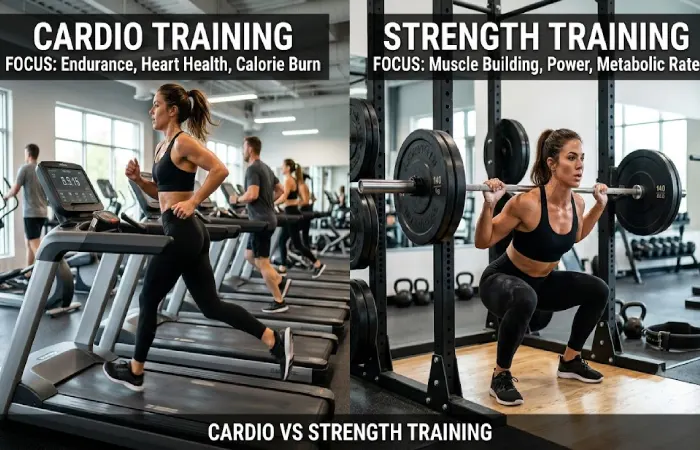
What Is Cardio Training?
Cardiovascular exercise consists of movements, which increase the heart rate during a longer time. For example:
- Walking.
- Running.
- Cycling.
- Rowing.
- Swimming.
- Stair climbing.
- Elliptical training.
Primary benefits:
- Improved heart health.
- Better endurance.
- Increased calorie burns.
- Better aerobic conditioning.
What Is Strength Training?
Muscle conditioning in which work is done on a muscle against an outside force.
Examples of this are
- Free weights.
- Resistance machines.
- Bodyweight exercises.
- Resistance bands.
- Kettlebells.
Primary benefits:
- Increased muscle mass.
- Greater strength.
- Improved bone density.
- Enhanced metabolic health.
- Better functional fitness.
According to the Cleveland Clinic, the ideal order of cardio and strength training depends on your specific fitness goals and training priorities.
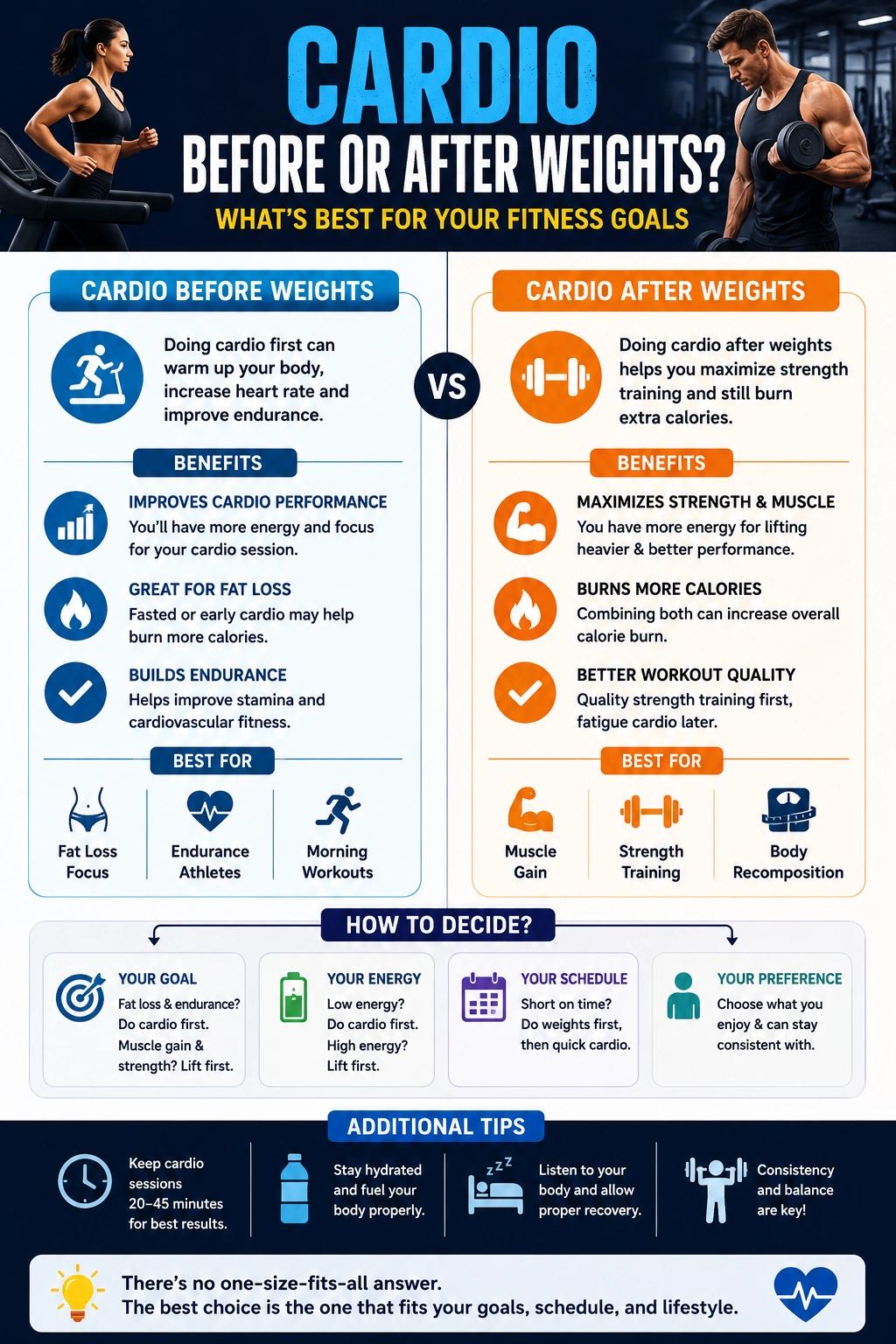
Cardio Before Weights: Benefits and Limitations
Benefits:
- Improved Endurance: When endurance sport training is your most significant objective, then starting your routine with some cardio will guarantee you have the largest supply of power readily available for this type of sport
- Warm-up Routine: Just moderate intensity of cardio is known to raise body heat and also get your body ready for more intensive training. When the focus is on training cardiovascular
- Increased Muscle Pain: Heavy lifting can cause the muscles to get to exhaustion to avoid more damage.
Drawbacks:
- Before lifting weights it may hurt your strength: You’ll most likely feel more beat when you move from a longer, more aggressive session of cardio to your lifts.
- Lift Less Weight: High-intensity cardiovascular exercise will exhaust your glycogen stores when you’re preparing to perform big lifts. This means you might… The next day, you may not be able to lift as much as usual.
- Perform fewer repetitions: Maybe you struggle to complete a third of your sets at the prescribed repetitions.
- Lower your workout intensity: Maybe you drop from three to two or two to one exercise for each workout.
- Less powerful: A lower body could be the result in power for explosive sports movements.
- May affect your muscles: According to many, you’re cutting into potential muscular gains by draining yourself prior to hitting the weights.
Cardio After Weights: Benefits and Limitations
Benefits:
-
Improved Strength Training Performance
Strength exercises generally require:
- Maximum focus.
- High energy availability.
- Neuromuscular efficiency.
Performing weights first allows lifters to train with greater intensity.
-
Better Support for Muscle Gain
For individuals pursuing hypertrophy, prioritizing resistance exercise may help maximize training quality.
-
Efficient Fat Loss Programmes
Some trainers suggest doing cardio postweights; resistance training depletes the energy stored in your muscles as glycogen, pushing your body to tap into reserves stored as fat more efficiently during your next session of aerobics. It can play a role in fat loss even though it’s your total calorie budget that really matters the most.
Limitations:
- You may feel fatigued during cardio sessions.
- Endurance performance may decline.
- Long resistance sessions can reduce motivation for additional cardio.
Cardio Before Weights vs Cardio After Weights: Comparison Table
| Factor | Cardio Before Weights | Cardio After Weights |
| Best for endurance | Excellent | Moderate |
| Best for muscle gain | Less ideal | Excellent |
| Best for strength | Moderate | Excellent |
| Cardio performance | Higher | Lower |
| Weightlifting performance | Lower | Higher |
| Fat loss | Effective | Effective |
| Suitable for beginners | Yes | Yes |
| Recommended for athletes | Goal-dependent | Goal-dependent |
Weights Before Cardio: What Does Research Suggest?
Research generally indicates that when strength and muscle development are primary objectives, performing resistance training first often produces superior outcomes.
This occurs because:
- Strength exercises demand high neuromuscular output.
- Fatigue from cardio may impair lifting performance.
- Heavier loads can usually be maintained when weights are prioritized.
- However, endurance athletes may benefit from reversing the sequence.
- No single workout order is universally superior.
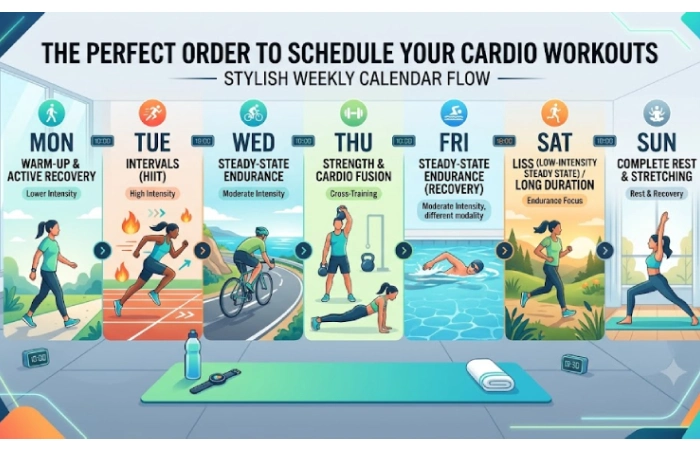
The Perfect Order to Schedule Your Workouts, So You Get Results
Cardio for Fat Burning
Weights first, followed by cardio
Reason:
- Maintains strength training quality.
- Supports muscle preservation during calorie deficits.
- Increases overall calorie expenditure.
Example Fat Loss Session
- Dynamic warm-up.
- Strength training (40 minutes).
- Moderate cardio (20–30 minutes).
- Cool down.
Cardio for Muscle Gain
Recommended Order:
- Weights before cardio
- Muscle-building programs should prioritize resistance exercise.
- Limit cardio volume to avoid excessive fatigue.
Recommended cardio:
- Walking.
- Cycling.
- Low-intensity steady-state cardio.
Cardio for Endurance Athletes
Recommended Order:
- Cardio first
- Runners, cyclists, and endurance competitors should prioritize sport-specific training.
Strength Training and Cardio for General Fitness
Recommended Order:
- Either sequence can work.
- Order matches your preferences.
- Encourages consistency.
- Fits your schedule.
Consistency matters more than perfect sequencing.
Which Category Are You?
| User Type | Recommended Order |
| Beginner | Personal preference |
| Weight-loss trainee | Weights then cardio |
| Bodybuilder | Weights then cardio |
| Powerlifter | Weights then cardio |
| Runner | Cardio then weights |
| General fitness enthusiast | Flexible |
| Older adults | Moderate, goal-based |
Morning Routine Suitability
If training early:
- Consider a short dynamic warm-up first.
- Prioritise your main goal.
- Avoid extremely intense fasted sessions if energy levels are low.
Example:
- Fat loss goal: weights → cardio.
- Running goal: cardio → weights.
Night Routine Suitability
Evening exercisers often have the following:
- Higher body temperature.
- Greater strength output.
- Improved flexibility.
If your goal is muscle growth, an evening training routine could prioritize resistance exercises.
Intense cardio right before bedtime may have an impact on a user’s sleep patterns.
Caution Advised:
Special considerations need to be made by some individuals:
- Older users.
- Any user who has heart disease.
- Any user in the process of healing after injury.
- Any user returning after having not trained in quite a while.
As with any new exercise regimen, it’s wise to check with the relevant health care providers and start training intensity slowly as appropriate.
Best Workflow: How to Choose your Workout order Practical Decision-Making Framework
Step 1: Choose Your Priority
Choose one:
- Fat loss.
- Muscle gain.
- Strength.
- Endurance.
- General health.
Step 2: Prioritise That Goal
Perform the most important activity first.
Step 3: Assess Recovery
Consider:
- Sleep quality.
- Nutrition.
- Training frequency.
- Stress levels.
Step 4: Evaluate Results After 4–6 Weeks
Ask:
- Are performance levels improving?
- Is recovery adequate?
- Are goals being achieved?
Adjust if necessary.
What Results Can You Expect?
The order of cardio and weights can influence training quality, but it is only one factor among many.
Progress also depends on:
- Nutrition.
- Sleep.
- Consistency.
- Recovery.
- Training volume.
- Exercise intensity.
After 4 weeks:
- Improved exercise tolerance.
- Better workout consistency.
After 8–12 weeks:
Noticeable improvements in strength or endurance.
Long-term:
Regular training can achieve substantial positive effects on the overall body composition and fitness. Know, that alone modifying the exercise order is highly unlikely to lead to a revolution in performance.
Advantages and disadvantages of training.
| Pros of Weights Before Cardio | Pros of Cardio Before Weights |
| Better strength performance | Better endurance performance |
| Supports muscle growth | Prioritises aerobic fitness |
| Useful for fat loss | Effective for runners |
| Higher lifting quality | Improves sport-specific training |
| Limitations of Weights First | Limitations of Cardio First |
| Reduced cardio energy | Reduced lifting performance |
| Fatigue during cardio | Possible decline in strength gains |
Different Ways To Integrate Cardio and Strength
You can’t just do the two in the same routine; you can break them up.
Separate Training Days
Example:
- Monday: Strength.
- Tuesday: Cardio.
- Wednesday: Strength.
Split Sessions
Example:
- Morning: Cardio.
- Evening: Weights.
This approach may reduce interference between training modes.
HIIT—High Intensity Interval Training
It mixes the cardiac muscle with the need for overall muscularity to give quick, effective, more powerful fitness bursts for people who are too time-poor or can’t or won’t stick with it longer. Ideal for:
- Busy individuals.
- Intermediate exercisers.
FAQs
What should I do weights or cardio first when looking to lose body fat?
Doing weights first is better for losing body fat since it helps preserve muscles but helps you burn more overall calories.
Is cardio bad for muscles before weights?
Not exactly. Short cardio sessions before weight training can’t really make too big of a difference to build muscle.
Are weights better than cardio for beginners?
Most beginners won’t see too much of a difference depending on their preferred workout.
Can I do cardio and weight training on the same day?
Certainly. I prefer doing weights first, so I make sure to do a 20 to 30 minute intense work-out for my cardio to ensure it helps for a great body fat decrease.
What cardio amount do I need in between weight training and after?
The amount depends on your preferred goal in working out, how conditioned your body is as well as your ability to recuperate.
Conclusion
Whether it is best to doing a cardio session prior to the free weights or after doing weights entirely depends upon your individual health and also fitness goals. Typically, if your purpose is to obtain muscle, improve your strength, or lose or gain body weight, it’s usually a good idea to do weights training in the gym prior to cardio. On the other hand, cardio workouts would possibly be much more appropriate initially if the primary objective is your athletic efficiency. But no matter you select, the exercise order ought to ensure that it permits you enough time to recoup between exercise disciplines and that you will likely maintain it up consistently in the future.
Cardio Before or After Weights Hub
Learn the best way to combine cardio and weight training for fat loss, muscle gain, HIIT workouts, workout scheduling, and overall fitness performance.