
Push Day Workout Split Explained
Introduction
People really like the push day workout at the gym. Beginners and experienced lifters and fitness experts all enjoy doing it. The push day workout is special because it works all the muscles you use when you push things. This is not, like routines where you work on one muscle group one day and then a different one the next day. When you do a push day workout you are working your triceps and your shoulders and your chest.
This Article Is Part of the Fitness Tips Resource Hub
Discover proven fitness strategies, workout plans, strength training techniques, cardio exercises, recovery tips, and healthy lifestyle advice in our Fitness Tips Resource Hub.
Push days are usually included within a larger split such as the push pull legs (PPL) workout split in order to improve training structure, recovery and training consistency. Whether you are looking to increase hypertrophy (muscle growth), your overall strength or simply to improve your general health and fitness you can improve efficiency of your workout by understanding push day split structure.
What is a push day workout split?
A push day workout split is an resistance training session for the training of push exercises.
The main muscle groups trained on a push day split workout include:
– pectoralis (chest muscles)
– deltoids (shoulders)
– triceps
When training a push day workout, selected exercises work on pressing/extension movements to ensure the muscles of pectoralis, shoulders and triceps are being worked.
Push-pull-legs training splits are commonly used to organize resistance training volume while allowing adequate recovery between sessions. The National Strength and Conditioning Association (NSCA) provides evidence-based guidance on strength training program design and exercise selection.
Common Push Day Exercises
The following exercises are the most commonly performed for a push day workout:
- Barbell Bench Press
- Dumbbell Shoulder Press
- Incline Dumbbell Press
- Arnold Press
- Push-Ups
- Cable Chest Fly
- Triceps Pushdowns
- Triceps Overhead Extensions
- Dips
Adjust the quantity and difficulty of these exercises according to current fitness level, available equipment, and desired outcomes.
How Push Pull Legs Works
The push pull legs system works by splitting your workout session into three movement patterns.
| Training Day | Primary Muscles |
| Push Day | Chest, Shoulders, Triceps |
| Pull Day | Back, Biceps, Rear Delts |
| Leg Day | Quadriceps, Hamstrings, Glutes, Calves |
This divides up the training and lets muscles rest while working another section.
Example Weekly PPL Workout Split
| Day | Workout |
| Monday | Push Day |
| Tuesday | Pull Day |
| Wednesday | Legs |
| Thursday | Rest |
| Friday | Push Day |
| Saturday | Pull Day |
| Sunday | Legs or Rest |
Frequency can also be affected by recovery capacity, age, experience level, and total training volume.
The optimal structure of a chest shoulder tricep workout
For the most part, chest shoulder tricep workouts follow a workout progression from large compound movements to smaller isolation movements.
Sample Push Day Workout
| Exercise | Sets | Reps |
| Barbell Bench Press | 4 | 6 to 10 |
| Incline Dumbbell Press | 3 | 8 to 12 |
| Dumbbell Shoulder Press | 3 | 8 to 12 |
| Lateral Raises | 3 | 12 to 15 |
| Cable Fly | 3 | 10 to 15 |
| Triceps Pushdown | 3 | 10 to 15 |
| Overhead Triceps Extension | 3 | 10 to 15 |
This provides balanced volume across all major pushing muscles.
Upper Body Push Workout Benefits
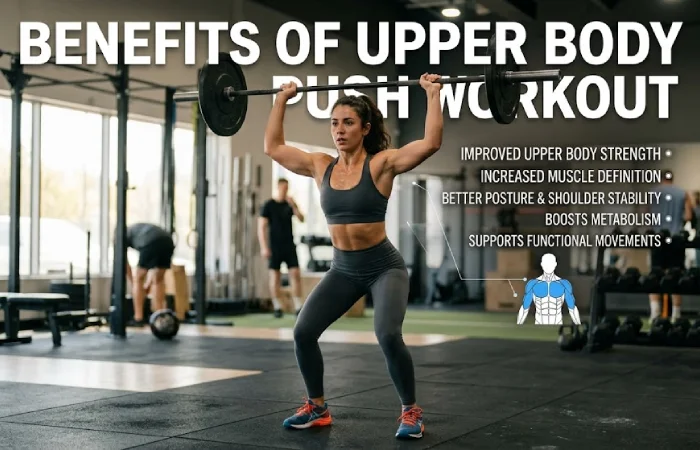
An upper body push workout offers several practical advantages.
Improved Training Organisation
Rather than having random groups of muscles work out together, the workouts are more organized and simpler to understand.
Better Recovery Management
Because pull and leg muscles are trained on separate days, push muscles receive recovery time before being worked again.
Progressive Overload Tracking
It becomes easier to monitor improvements in pressing strength and exercise performance.
Flexibility for Different Goals
Push workouts can be modified for:
- Muscle growth
- Strength development
- General fitness
- Athletic performance
Push Day Workout Workflow
The following workflow can help maximise workout efficiency.
Step 1 Warm up
- Do the following 5-10 minutes
- Light cardio
- Dynamic shoulder movements
- Band pull-aparts
- Push-up variations
Step 2: Compound Movements
Begin with heavy multi-joint exercises:
- Bench Press
- Incline Press
- Shoulder Press
Step 3: Assist Movements.
Include slightly higher loads in your movements to help focus on the areas.
Examples include:
- Cable Flys
- Incline Dumbbell Press
- Machine Chest Press
Step 4: Isolation Work
Finish with triceps and shoulder isolation exercises.
Examples:
- Triceps push downs.
- Side raises.
- Skull Crushers
Step 5: Recovery
Support recovery through:
- Adequate sleep
- Proper nutrition
- Hydration
- Planned rest days
Push Day Workout Split vs Full Body Training
| Factor | Push Day Split | Full Body Training |
| Workout Focus | Specific muscles | Entire body |
| Session Length | Moderate | Longer |
| Recovery Management | Easier | More demanding |
| Exercise Volume | Higher per muscle | Lower per muscle |
| Suitable for Beginners | Yes | Yes |
| Suitable for Advanced Lifters | Yes | Yes |
Neither method is “better”. You have to choose based on time available, goals, recovery and also what feel right for you.
Expectations: What Can you realistically expect to achieve?
A push day workout split can contribute to muscle development and strength improvements when combined with:
- Progressive overload
- Consistent training
- Adequate protein intake
- Sufficient recovery
However, results vary significantly.
Factors influencing progress include:
- Training experience
- Genetics
- Nutrition quality
- Sleep habits
- Overall training programme
Some people will see gains in their technique and strength in a matter of weeks, but gains in size are likely to take months of consistently following a training program rather than days or weeks.
Common Push Day Mistakes
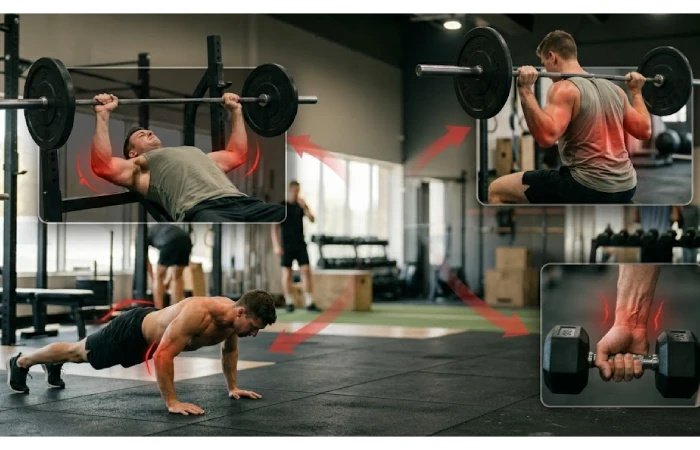
Training too heavy, too soon
This can lead to bad form, resulting in injury, and slower progress.
Ignoring shoulder health
No exercise sessions should skip shoulder prehab/rehab and Mobility.
Training too much volume
Too many push day exercises performed for your chest and triceps will reduce your recovery rate and muscle gain potential.
Picking bad exercises
The reliance on either just machines or just isolation exercises for push day is likely to decrease efficiency and progress within your training split.
Insufficient recovery
The workout doesn’t grow the muscles, the recovery does.
Individuals following a PPL workout split
May Require Modifications
People recovering from shoulder injuries
Older adults with joint limitations
Individuals with restricted training schedules
Your workouts should always be individualized based on you and how your body feels at any given time.
Pros and Cons
Advantages
- Easy to follow
- Efficient muscle grouping
- Supports progressive overload
- Flexible exercise selection
- Compatible with most gym environments
Limitations
- Requires consistency
- Recovery must be managed properly
- Not always ideal for very limited schedules
- Can lead to overtraining if volume is excessive
Chest & Triceps Workout Resource Hub
Master chest and triceps training with beginner plans, gym workouts, home workouts, dumbbell exercises, push day splits, and advanced routines.
Commonly Asked Questions
Let’s go into what exactly a push day workout split is!
A push day workout split is a training session that’s all about the chest, shoulders and triceps. This workout focuses on movements where you push weight away, from your body. You do exercises that work the chest, shoulders and triceps like pushing weight from you. The chest, shoulders and triceps are the muscles you work on during a push day workout split.
Is a push day workout split good for beginners?
Yes. It’s typically easy for beginners to master technique and stay consistent with the push pull legs split.
How many exercises on a push day?
On average you’ll be anywhere between 5 and 8 exercises with that number varying based on your level of experience and recoverability.
Can I build muscle with a push day workout split?
Yes. With correct nutrition, recovery, and progressive overload, a push day split will enable muscle gain.
How many times a week should I train push day?
People usually do push day one or two times a week. This is because they are following a routine that includes push, pull and legs. They like to separate these things so they can focus on push day and really work on it. Push day is a part of the push pull legs routine that most people do.
Conclusion
One of the most logical and well designed methods for arranging upper body workouts are using a push day workout split. Training the chest, shoulders and triceps within one single workout will provide a better quality workout, enable greater recovery and will be easier to track progress against. A well-constructed push day can either be part of a broader full push pull legs program, or a program created solely for you; no matter how you do it consistency, perfect technique, correct nutrition and the right level of expectation will bring about sustained and optimal progress.