
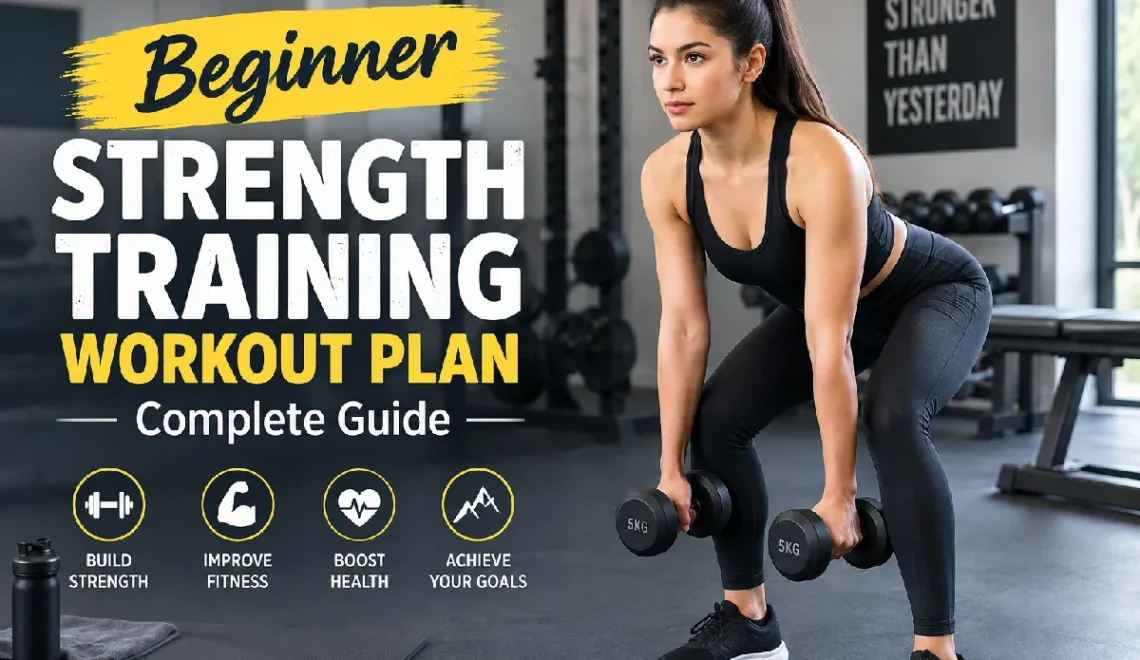
Beginner Strength Training Workout Plan: Complete Guide
Last Updated: September 14, 2026
Strength training is not only something experts can achieve. Through an introductory approach resistance training would guide new exercisers to gain strength, improve on coordinated movements, and obtain body awareness through exercise. An introduction program for strength training should be based around fundamental exercises, suitable intensities, and repetition as opposed to how heavy can you lift it.
Strength training can be conducted with in your home or at a health club facility. Use resistance bands, bodyweight exercises, barbells, dumbells and machines as appropriate to your experience levels, goals, equipment capabilities, and preferences.
Where should beginners start in strength training?
Beginners just need to master a few basic movement patterns to begin with. Here they are:
- Squatting
- Lunging
- Pushing
- Pulling
- Hip hinging
- Carrying
- Core stabilisation
A good basic full body work out can be done twice or 3 times a week for all of these.
Beginner Strength Workout
| Exercise | Sets | Repetitions |
|---|---|---|
| Bodyweight squat | 2–3 | 8–12 |
| Incline push-up | 2–3 | 6–12 |
| Glute bridge | 2–3 | 10–15 |
| Resistance-band row | 2–3 | 8–12 |
| Reverse lunge | 2 | 6–10 each side |
| Dead bug | 2 | 6–10 each side |
Allow yourself rests between sets as necessary. Pick a variation to the exercise which enables you to keep your technique half decent.
5 Best Beginner Strength Exercises
Squats
Build your lower body strength without weights – you can even use a chair for guidance.
Push-ups
Wall or incline push-ups can make an accessible starting point if full push-ups are beyond your reach.
Glute bridges
Lie on the floor, engage your glutes and lift your hips off the ground. Focus on movement control.
Rows
Work your pulling muscles using resistance bands, dumbbells or a machine.
Lunges
The reverse lunge can often feel more controlled than a forward lunge. You can use a chair to help with your balance.
Core exercises
Develop your control and core strength using exercises like dead bugs or bird-dogs, rather than by lifting heavy weights.
Weight Training Programme for beginners
When you decide to train with weight, then make sure, your resistance lets you learn to perform the exercises well.
For example when you use weights for a movement in dumbbell-training, you shouldn’t swing your body too much or lack control at the end of the reps.
One possibility of progression is this:
- Week 1: Learn to perform movements.
- Week 2: Keep on with performing the exercises.
- Week 3: When it is suitable add two more repetitions.
- Week 4: Slowly increase the weights if you feel like your workload is not too much.
Progress is not required in every session.
At-home beginner resistance-training workout
It’s not very difficult to build fundamental resistance training program using few equipment.
The resistance band can be applied as
- Rows
- Chest presses
- Banded squats
- Glute exercises
- Shoulder exercises
You could, if you have adjustable dumbbells, just increase resistance as you get stronger.
However you don’t need equipment at all at the very start as training with your own bodyweight can show you some key movement patterns.
Weekly Beginner Strength Training Routine
Using a three-day approach will keep the strength training regular but also allow for rest between workout days.
| Day | Workout |
|---|---|
| Monday | Full-body strength |
| Tuesday | Rest or easy walking |
| Wednesday | Full-body strength |
| Thursday | Rest |
| Friday | Full-body strength |
| Saturday | Light cardio or mobility |
| Sunday | Rest |
If three strength sessions is a lot to take in to begin, you may choose to focus only on Mon/Thur sessions and add an additional session later.
The most optimal schedule will be dependent on where your current fitness level is at. It must also be sustainable.
What Weight Should a Beginner lift?
There isn’t one standard starting weight; all people vary in strength and previous training.
Select a resistance that enables you to do the planned reps and maintain technique throughout. Early sessions should focus on technique over maximal strength testing.
Increase resistance gradually as your ability improves for any given exercise.
Do not make large jumps up in resistance just because you are able to one max rep more at an increased weight; this is the principle of strength training.
How to gain progress in strength training:
When progressive overload means the progressive overload of your muscles (which simply means you keep putting new demand on your muscles). This happens for an:-
beginner in one of two ways:
- Adding repetitions
- Increasing resistance
- Adding a set
- Using a more difficult exercise variation
- Improving movement control
- Increasing training frequency when appropriate
For example, if you can comfortably perform 8-10 repetitions with a certain resistance, you would gradually work towards the highest part of your range before doing a small increase in the resistance.
Recovery & Resistance Training
When building strength, recovery is a key component to progress.
It is important to provide sufficient recovery time between the resistance training sessions. Considering that you are a beginner you should factor in sleeping, sufficient nutrition, a large number of fluids and general movement of yourself.
Some muscle tenderness may occur when commencing any new program, however this discomfort should not be considered standard/a necessary part of reaching a target.
If you continually feel unusually tired or if your performance is constantly decreasing, dial the workout load back and re-examine recovery.
What a Beginner Can Expect?
For beginners, rapid gains may be noticed during the early stages of training due to the introduction and learned adaptation of new exercise patterns.
Every individual has different outcomes; some factors affecting the results achieved by a client:
Training consistency
- Starting fitness
- Exercise selection
- Nutrition
- Sleep
- Recovery
- Age
- Genetics
Don’t go into this expecting drastic changes after a few sessions. Initial progress can look more like improved technique, more reps performed or being able to handle a little more resistance.
Most Popular Beginner Strength-Training Mistakes.
- Training too heavy. This compromises technique.
- Training every day. Muscles need a rest period after an intense resistance workout.
- Copying experienced lifters. This might not be suitable for you to be starting on.
- Swapping exercises every day. The same basics movements can allow you to work on technique and monitor progress.
- Neglecting technique. Weight should not be important over performing the movement controlled.
FAQs
A beginner’s strength training workout routine definition?
A beginner’s strength training workout routine is resistance-training program designed for novice exercises that focus on teaching you fundamental motions and building strength systematically.
Number of days for the beginner strength training program?
Two or three per week are achievable in the beginner phase, with at least one day rest in between 2 days of serious lifting:
Which strength exercises should a beginner start with?
Squats, lunges, press-ups, rows, glute bridges and essential core exercises form a good starting foundation. Your relevant form will be dependent on where you are now in the fitness process.
Do beginners need to lift weights for strength training?
No. Bodyweight will be enough for a beginning. Resistance bands, dumbbells and machines may well then follow.
Should a beginner’s strength training sessions be long?
For beginners a full-body session lasting about 30-45 minutes, including the warm up, would be appropriate.
Conclusion
A training plan for beginners should also focus on familiarising yourself with correct movement patterns, building strength systematically and creating a habit of resistance training. When resistance training, you should start with appropriate weights/resistance, focus on correct form and permit sufficient rest between sessions. Initially body weight exercises could be done and resistance bands or machines introduced as strength increases. Progress with good control is more important than lifting the heaviest weights, so while focusing on gradual increase in repetitions and then weight is important.