
Muscle Building Peptides Side Effects
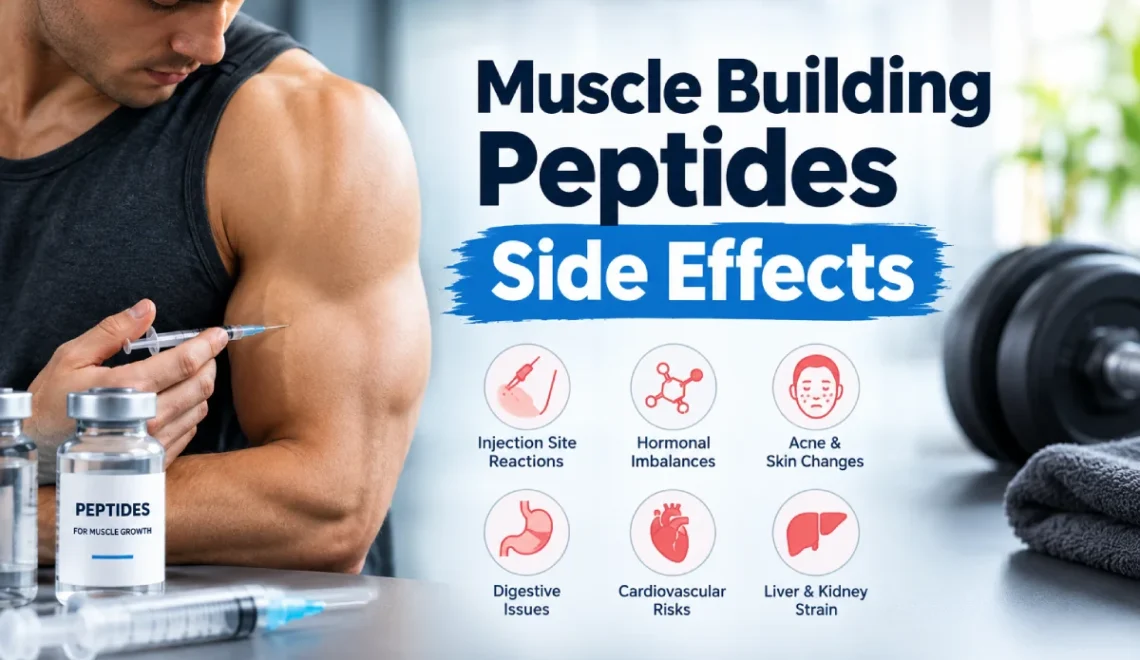
Muscle building peptides appear in discussions primarily centered on how to manipulate muscle growth, recovery, GH signaling, and body composition. Nevertheless, the ability to alter such things is not entirely without risk. Muscle building peptides side effects will depend heavily on which peptide is involved, where it is intended to act biologically, how it is presented (formula), how it will be administered, and each individual’s specific health.
Additionally, an important distinction must be made between authorized peptide medicines and unlabeled experimental drugs sold on the internet; there are approved applications for certain peptides but other peptides may not even have limited human safety data available at this time, and one can not necessarily apply generalized benefits/side effects to each peptide.
This Article Is Part of the Muscle Building Hub
Explore muscle-building workouts, training plans, exercises, recovery tips, and other useful information in our Muscle Building Hub.
Changes in blood glucose
Certain peptides that affect GH or pathways involved in metabolism may have effects on glucose levels.
GH itself impacts glucose metabolism and insulin action, alterations in these pathways could possibly lead to blood glucose changes and/or changes in insulin sensitivity in predisposed individuals. This applies especially to individuals who are already diabetic or are metabolically predisposed.
This information is of especial interest for individuals who already have prediabetes or a diagnosis of diabetes; an individual should not rely on the peptide not being classified as an anabolic steroid to know that it may not impact metabolism in some capacity.
Water Retention/Swelling
Fluid retention can be a side-effect in relation to certain growth hormone related supplements. Fluid retention can be evidenced in the form of:
- Swelling in the hands or feet
- Puffiness
- A temporary increase in body weight
- Feeling unusually tight or uncomfortable
The increase in weight could not necessarily be attributed to new muscle mass but rather water retention: The increase in your body mass after commencing treatment for example can be partially accounted for by water retention. Persistent and significant edema will require medical examination.
Joint or muscle pain

Increases in fluid level changes and growth signals can occasionally be accompanied by joint pain/stiffness and/or muscles aches.
These signs can be confusing in regular trainees, as they are common post exercise soreness symptoms. If aches are not typical, and persistent/severe, one should look deeper.
Headaches and Dizziness.
Headaches may occur with a few hormone or drug-based remedies and peptide related molecules are similarly capable of causing some headaches, dizziness etc, depending upon the particular one. However the cause of headaches is extremely broad, and can be related to insufficient food/drink, or lack of sleep/excessive training.
New or existing headaches/dizziness as a result of taking drugs are more of a consideration however.
If very acute headaches occur along with fainting, confusion, visual disturbance or any other alarming sign an investigation is needed immediately.
Pain at Injection Site
Most peptides in the body building scene are injected, not consumed orally like a typical supplement. Possible injection related issues may include:
- Redness
- Pain
- Swelling
- Bruising
- Itching
- Irritation
There is also the chance of infection on the administration of injected materials if they are contaminated or misused. This is really a key difference between peptide products and standard sports products. An injected product relies on correct medical administration and high quality manufacturing standards.
For reliable information about potential peptide-related risks and adverse effects, readers can refer to the U.S. Food and Drug Administration (FDA) for official drug safety guidance.
Infection / Contamination Issues
Product quality can be as important as the peptides. Items bought from “unknown online vendor” sites can suffer from:
- Contamination
- Incorrect concentration
- Impurities
- Incorrect labelling
- Poor storage conditions
- Lack of reliable quality control
Injected products give reason for even greater concern, since foreign materials may directly access the body. The FDA has cited problems with some compounded peptide products and acted against companies selling unapproved peptide products.
Hormonal effects

Peptides that stimulate or inhibit growth hormone, or others endocrine axes could influence body hormonal balance. Since these axes are closely related one influencing the other.
The concern is context-dependent and the modification of one can affect another system.
Side effects could be due to changing of
- Growth hormone signalling
- IGF-1 levels
- Glucose metabolism
- Fluid balance
- Appetite
- Other hormone-regulated processes
This is one of the many reasons that the experimental peptides should not be thought of as nutritional supplements.
Immune response
It is possible for peptide products to evoke an immune response. A person injected with a peptide preparation or impurities contained within may recognize them as foreign agents and induce an immune response. An immune response, and it’s potential severity, are specific to the compound involved.
The FDA has noted concerns regarding immunogenicity and peptide impurities for several compounded substances.
Because not many research peptides have been evaluated extensively through prolonged safety studies, all possible immune effects of peptides are not understood at this time.
Unforeseen Long-Term Outcomes:
A major unknown concerning experimental peptides is a general lack of extensive studies on the long term effects on humans. A compound may have been experimented on in laboratory trials, or small clinical trials, but without enough data on long term casual use to tell how it affects a person. Among some unknowns include:
- Long-term hormonal effects
- Metabolic health
- Cardiovascular effects
- Immune responses
- Interactions with other substances
- Effects of repeated exposure
Absence of evidence of harm is not evidence of absence of harm, and certainly not evidence of safety.
Drug Interactions
Peptides that have hormonal or metabolic actions are likely to interact with certain medications that the patient is already receiving. This is an important consideration if the patient is taking medications that affect:
- Blood glucose
- Hormone levels
- Blood pressure
- Metabolism
- Other endocrine functions
A person currently under prescription medication use should seek medical advice regarding the use of any peptide related treatment from a legitimate professional and not just mix products based upon a web protocol.
The side effects are also peptide-dependent.
A definitive list of side effects cannot be given for peptides as it can vary widely from substance to substance. A peptide, for instance, influencing growth hormone release may represent a different risk to an investigational tissue repair peptide or a regulated medicine where a greater number of safety parameters are investigated, compared to an non-regulated substance purchased on the black market. Claims such as ‘no side effects occur from using peptides’ must therefore be taken very carefully indeed; the substance does matter
Added Risks to Purchasing Online Peptide Products
Additional uncertainty exists when you buy peptides via social media sites, less formal websites, or vendors who have listed products under a research chemicals header. A batch may actually be less concentrated or fail to include the compound being sold. Storage and cleanliness might also be questionable. “Research use only” does not make something “good to inject”.warnings and enforcement actions are present by the FDA
Who needs to be particularly careful?
If you have pre-existing medical conditions, you will need to be particularly careful with compounds which will influence hormones or metabolism. Examples of who should exercise precaution are the people who have:
- Diabetes or blood glucose problems
- Hormonal disorders
- Cardiovascular conditions
- Kidney or liver problems
- A history of significant medication reactions
- Other conditions requiring regular prescription treatment
If you are pregnant or breastfeeding, do not start testing out and “making your own compounds” of untested performance enhancing agents without speaking with your doctor.
Younger, teenaged individuals too should not begin experimenting with bodybuilding peptides, especially considering that hormonal systems have not even completed their development.
What warrants medical assistance?
Any user of any pharmacological substance should investigate an otherwise atypical or concerning symptom.
Consult your physician for such symptoms as
- Severe or persistent headache
- Difficulty breathing
- Significant swelling
- Chest pain
- Fainting
- Severe allergic-type reactions
- Signs of infection at an injection site
- Sudden changes in vision
- Severe weakness or confusion
It is not something that should be ignored as an “occupational hazard of bodybuilding/working out” and just carried on with as normal.
Peptides vs. typical supplements on the market
It’s not safe to just group peptides in with your common protein powder or creatines.
Protein is designed to help achieve the user’s macronutrient requirements. Creatine monohydrate too, is well studied for strength & anaerobic training.
With peptides, biological signaling pathways, for example, are sometimes able to be manipulated by this class of supplements.
That fact makes evidence based and medical supervision, product quality and the current regulatory aspect of peptide usage far more relevant.
Final Takeaway
Muscle-building peptides and their various side effects largely depend on what the compound targets biologically. For example, one might potentially experience changes in blood glucose, edema, headache, joint pain, local reaction at the site of injection, or infection, immune stimulation, or hormonal change. Another side effect is a general lack of definitive knowledge concerning the long-term effects.
This risk profile is perhaps exacerbated by uncertified suppliers and lack of medical monitoring. Many of the substances readily available online for the purpose of muscle growth have significantly less safety evidence in human beings compared to pharmaceuticals or even the supplements well-established in the sports nutrition realm.
For the individual looking to promote muscle gain the cornerstones are appropriate progressive resistance training, nutrition, and sleep and recovery. In cases where an individual’s motivation is medical in nature for use of a specific peptide, investigating that compound’s body of evidence as prescribed by health care professional is safer than following bodybuilding based dictates found online.
Muscle Building Peptides Hub
Explore the complete guide to muscle-building peptides, including how they work, types used for muscle growth, potential benefits, side effects, legal considerations, and how they compare with supplements.