
Beginner Workout Plan: A Complete Guide to Starting Your Fitness Journey
Last Updated: September 13, 2026
Beginning a workout routine can be daunting if you are unsure which exercises to focus on, how many days a week to exercise, or whether you’re really doing enough to get stronger. But a great beginner workout doesn’t have to be complex – it’s best to begin with simple exercises, teach yourself efficient movement patterns, and gradually build up as you feel yourself getting fitter. If you are aiming to be stronger, improve your general health, become more flexible, or just want to become more active, a defined schedule can remove some of the guesswork.
We guide you through starting to exercise, including providing a realistic weekly workout program, and discuss necessary equipment, recovery, and progression advice.
A beginner workout program is just a scheduled period of exercises tailored for individuals that have just commenced or recently stopped training and haven’t exercised consistently in a while. This may well be structured to improve strength, cardiovascular health, mobility, recovery, and other skills while allowing for adaptation.
A beginner training plan—what goes where?
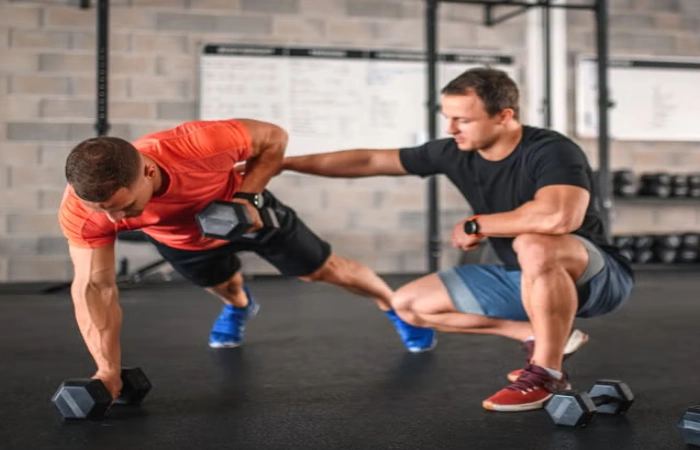
A good beginner training plan will not be complicated—easy to stick with, yet varied enough to cover all areas of fitness for a beginner to build up.
Major elements of training are
- Muscular Endurance—Moves every major muscle group
- Cardio—walking quickly, jogging, swimming, or cycling.
- Mobility—moves that slowly run the body through all of its range of motions of a joint.
- Training of core work that will build abdominal, lower back, and side ab muscles.
- Recovery—a planned activity day, light cardio, and a complete rest day.
You do not need to perform all these types of exercise in each workout; beginning with three dedicated training sessions each week would likely see more gains than attempting to train heavily every single day and burning out quickly.
Get into your workout as a beginner.
In order to start exercising right from the beginning, focus more on a practical exercise regimen rather than on a highly sophisticated exercise method.
1. State your goals
What you want to achieve impacts how you plan out your exercise routines.
Here is an illustration.
| Goal | Useful training focus |
|---|---|
| General fitness | Strength + cardio + mobility |
| Building basic strength | Full-body resistance training |
| Improving stamina | Walking, cycling, swimming or other cardio |
| Improving mobility | Mobility and controlled movement |
| Supporting weight management | Regular activity + strength + cardio + appropriate nutrition |
| Preparing for gym training | Basic movement patterns and resistance exercises |
It is not necessary for new practitioners to only have one objective. General fitness would work well while trying to identify preferred training style.
2. Work with suitable session length
A 30-45 minute session may well work for a novice practitioner, one should feel that they have worked by the end of it, but not exhausted.
Shorter sessions should still be of some value to someone who has been a couch-potato for a significant period of time. One should try to keep one’s commitment feasible.
3. Focus on basic movement patterns
Rather than memorising dozens of exercises, there are six basic patterns that a newcomer should learn first and foremost:
- Squat
- Hinge
- Push
- Pull
- Lunge
- Carry
- Stabilization
Each of these could be trained bodyweight or with minimal resistance.
4. Make incremental steps of progress
When an exercise feels notably easier than when one first attempted it one could introduce additional repetitions, increase the resistance, time or complexity. There is no need to do all at once.
Beginner Workout:
This program is offered as a good basic starting guide to exercise for fit healthy individuals who are relatively new to it. Beginners should ensure the intensity of the work, and choice of exercise match the level at which they are comfortable.
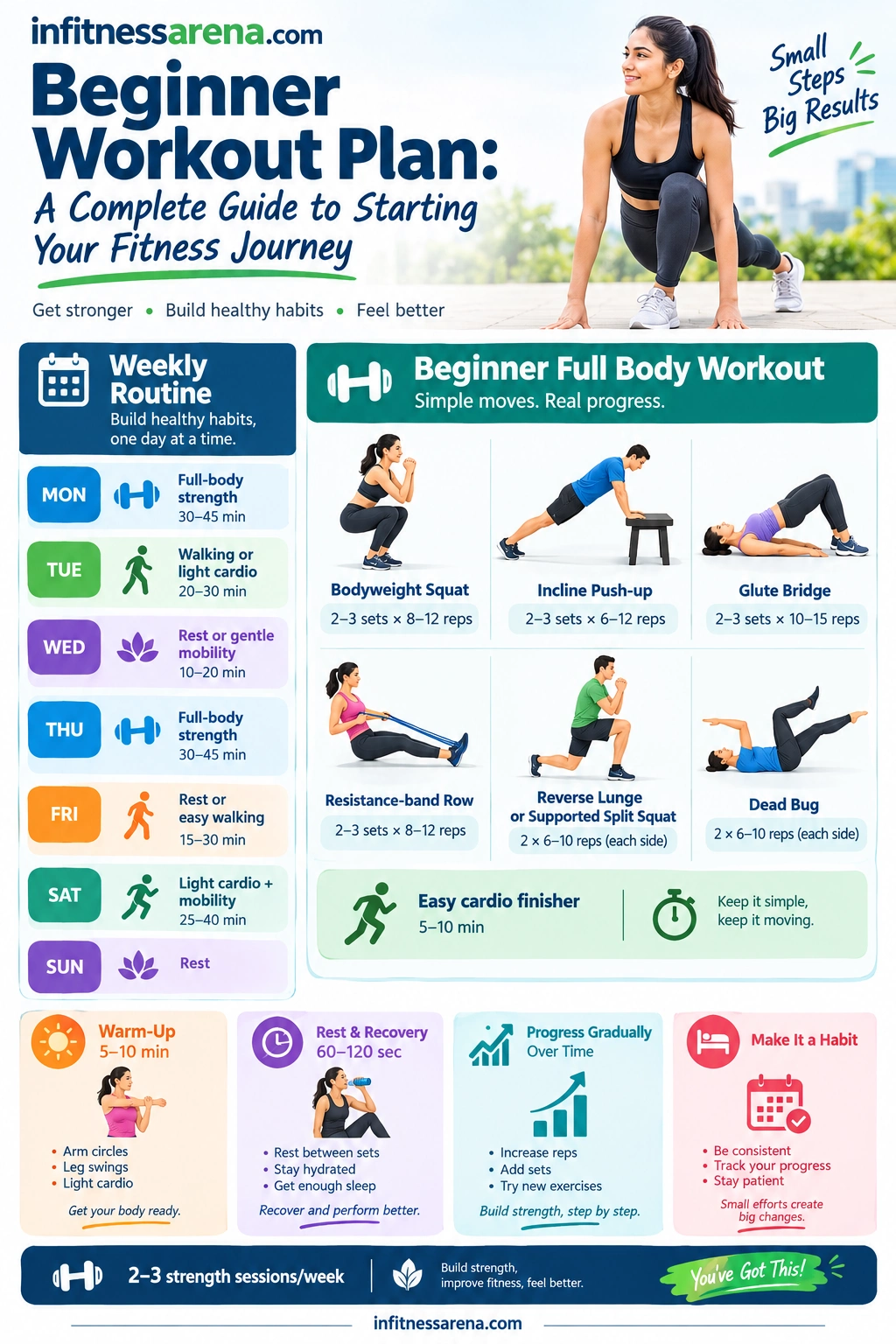
Weekly workout for beginners
| Day | Activity | Approximate duration |
|---|---|---|
| Monday | Full-body strength workout | 30–45 minutes |
| Tuesday | Walking or light cardio | 20–30 minutes |
| Wednesday | Rest or gentle mobility | 10–20 minutes |
| Thursday | Full-body strength workout | 30–45 minutes |
| Friday | Rest or easy walking | 15–30 minutes |
| Saturday | Light cardio + mobility | 25–40 minutes |
| Sunday | Rest | — |
The days may be reshuffled to meet your needs, the intention being a manageable, consistent routine rather than adhering strictly to Mon-Sun.
Beginner Full Body Training
Complete a brief warm-up before starting the following exercises.
Warm-up: 5-10 mins: Brisk walk, Arm circles, Shoulder rolls, Hip circles, Gentle body weight squats, marching on the spot: the body needs to warm up and get ready for what you’re about to make it do.
Main workout
| Exercise | Sets | Repetitions |
|---|---|---|
| Bodyweight squat | 2–3 | 8–12 |
| Incline push-up | 2–3 | 6–12 |
| Glute bridge | 2–3 | 10–15 |
| Resistance-band row | 2–3 | 8–12 |
| Reverse lunge or supported split squat | 2 | 6–10 each side |
| Dead bug | 2 | 6–10 each side |
| Easy cardio finisher | 1 | 5–10 minutes |
Take about 60 – 120 seconds rest between sets if you feel its necessary. For the beginner, just try and get quality and not speed of the reps.
If a movement feels painful or abnormal, abandon it and try the set with an alternative exercise rather than attempting to fight it.
Beginner Exercise Routine: Exercise explanations
- Bodyweight Squat: This exercise involves positioning your feet roughly shoulder width apart. Keep your midsection braced whilst you sit your hips back lowering yourself down. Keep your feet fixed while you do this.For squats: If standard squats are too strenuous, do lowering in to and raising up out of a stable chair.
- Incline Push-Up: Rest your hands upon a stable elevated surface such as a desk, table or kitchen worktop. Keep your body under control and you should gradually lower yourself toward the surface before pushing back away. The incline make it a far easier exercise than a conventional floor push-up.
- Glute Bridge: While resting on your back with your feet flat on the floor and your knees bent, try to raise your hips, taking care to keep it under control and then lower them down slowly. This is a good low impact exercise for working on hip extension.
- Resistance Band Row: Position the band, with one or both hands in the band. Keeping your shoulders still, try and pull the band toward your torso. This helps you build strength in pushing exercises, such as the floor push up, and complements push focused exercise.
- Reverse Lunge: Take a step back with one leg, trying to control the movement on the way down into a comfortable, stable range. You push back toward the starting position to reset the movement. A steady chair or table to hold onto can be used, should there be any difficulty with the exercise’s stability or balance initially.
- Dead Bug: Start by lying flat on your back, assuming the correct position. Gradually extend one limb away from your trunk while simultaneously moving the opposite limb back toward the ground. The key with this exercise is quality of movement with a stable core rather than volume.
How hard should a beginner’s workout be?

One of the biggest pitfalls beginners run into is thinking a good workout has to have them wiped out. It doesn’t.
A beginner workout should, for the most part, feel difficult but doable.
During resistance training, the lifter should generally be able to keep the weight under control and their form strong instead of pushing through more reps and compromising form. A good guideline here would be that on most sets, you should end it feeling like you could theoretically do a few more reps with good form. Cardiotraining intensities can be different depending on where the exerciser is in their fitness journeys. While a hard walk might be very difficult for someone with a completely sedentary lifestyle, it would be fairly easy for someone already doing some recreational running.
Individual experiences will vary and not all people are feeling identical amounts during identical workouts.
Beginner’s workout plan for the first four weeks
By adopting a spaced four week routine you prevent yourself from over doing it initially.
Week 1: Learn the program
Concentrate on:
- Learning the proper form for exercises
- Two sessions in which you do two strength workouts.
- Regular walks.
- Learning about your own body.
- Avoid anything high intensity that is not needed.
The first week of exercise should really just involve learning exercises, and not trying to see how fit you can become.
Week 2: Make it a habit
Continue with two full-body strength workouts and consistent light/moderate activity.
If Week 1 was relatively comfortable and easy for your body, it is ok to slightly increase the number of repetitions of certain exercises.
Week 3: Start gradual increases.
A single change may be to add one of the following:
- One extra repetition
- One slightly increased load
- An extra set of the certain few exercises.
- One increased duration walk.
- Only change one aspect of the program at this point, and ensure that the technique for the change is correct.
Week 4: Evaluate how things are going
Evaluate:
- Has exercise became easier for me?
- Am I capable of lifting more repetitions?
- Is my recovery becoming quicker?
- Do I actually enjoy this regime?
- Are there some exercises I find painful?
- Am I getting through each session that I plan to?
Depending on your answers, you will be able to make adjustments for the rest of the month.
Beginner Home Exercise Equipment
You do not need a big home gym when starting out.
Bodyweight exercises are a great starting point, but some simple equipment can make the journey further and more interesting.
Useful beginner equipment
- Exercise mat—beneficial for performing ground exercises, mobility work, and core work
- Resistance bands—portable and reasonably versatile for movements such as rowing, pressing, lower body work, etc.
- Adjustable Dumbbells—useful if you want to increase the load gradually without buying lots of separate weights.
- Stable Bench or Step—useful to perform supported exercises, perform push-ups on a range of inclines, and certain strength exercises if specifically designed for it
- Comfy footwear – this will vary depending on what you’re planning to do: running, walking, indoor work
Your program should define what equipment you use, rather than it determining your program. It is generally a good idea not to invest in and buy multiple pieces before establishing a consistent habit.
Beginner Workouts: Bodyweight vs. Equipment-Based.
There are benefits to both for an amateur:
| Factor | Bodyweight training | Equipment-based training |
|---|---|---|
| Cost | Low | Moderate to high |
| Space required | Minimal | Depends on equipment |
| Learning curve | Generally low | Varies |
| Progression | More difficult for some exercises | Easier to increase resistance |
| Convenience | Very high | Depends on setup |
| Exercise variety | Moderate | High |
| Best for | Starting with minimal equipment | Progressive resistance training |
You don’t have to commit to either a bodyweight start or resistance bands from the outset when you are beginning. You can build your bodyweight routine up over time then gradually add the resistance bands or dumbbells to training.
Getting started with working out how to get stronger—safely
Progressive overload is when you incrementally make the stress your body is put under increase.
It does not require doing a large amount of weight at any stage, particularly in beginners.
You can achieve it by:
- Increasing the reps within your rep range.
- Adding a small increase of weight or resistance.
- Adding a set.
- Improving motor control over the movement.
- Making the exercise itself more difficult.
- Gradually increasing cardio time.
E.g., if your starting point is doing 8 bodyweight squats in your first week, once you can do this over time, you’ll be working toward 10-12 reps in each, performing it slowly and under full control, before adding any weight/resistance.
This allows your body the opportunity to adapt.
Don’t alter multiple variables at once.
If you increase the load, reps, number of sets, and session frequency all at the same time, you won’t be able to see whether it’s the correct stimulus or just too much at once. Alter 1 or 2 variables each week and then see how your recovery is.
Beginner Cardio Circuit
It doesn’t always mean that working on the cardiovascular needs running.
For beginners this could be:
- Brisk Walking
- Cycling
- Swimming
- Dance/Zumba
- Low-Impact Aerobics
- Elliptical machine training
- Sports-recreational games of tennis, basketball, etc.
An easy program could be like this:
| Stage | Example |
|---|---|
| Starting point | 15–20 minutes of comfortable activity |
| Early progression | 20–30 minutes |
| Developing routine | 30 minutes several times per week |
| Further progression | Gradually increase duration or intensity. |
Pick an exercise or activity that you would continue with no problem. A workout that you will find enjoyable and comfortable will be easy to stick with.
Strength Training and Recovery
Recovery time is required by muscles and other tissues of the body as a response to training loads.
For the novice developer, full-body resistance exercise sessions on alternating days of each other, or on separate days, will allow for appropriate amounts of recovery time.
Additional sources of recovery time are also to be included:
- Sleep
- sufficient food and fluids
- Rest days
- Overall level of activity
- No unnecessary exercise when in excessive pain
While some muscle soreness is often to be expected from a new exercise program, extensive or severe pain is not.
What do I need to expect? When will I notice changes?
You won’t see results with training on the same timescale.
This will vary depending on:
- Your beginning fitness level
- Your age
- How consistently you are training
- Which exercises you choose
- Your diet
- Sleep
- Recovery
- Your genetics
- Your previous training experience
You should experience changes in skill, coordination, and confidence, as well as ability within training, and you will likely experience this fairly soon. Physical changes, however, may take some time, and there is also variability as to how long it may take to begin seeing results.
For a beginner, it would be sensible to work first on adherence and ability, instead of expecting results over the first few weeks and hoping that your appearance will have transformed dramatically.
For instance, being able to achieve more controlled, balanced squats, be able to walk without being uncomfortable for long periods of time; or working through an entire session without fatigue can be viewed as positive progress even if your appearance has altered very little.
Beginner Errors to Avoid
Volume Too Early
Too many intensive workouts per week, six to seven say, hinder recovery too easily.
Mimicking Advanced Schedules
A plan suitable for the seasoned athlete is far from necessary for the novice training regime.
Neglecting Technique
As quality is reduced, the increase in reps becomes futile; you cannot repeat actions not performed adequately in the first place.
Routine Hopping
You gain fitness through a constant, repeated struggle with exercises, so changing your program will make your improvement less observable.
Achieving success is an objective for many users.
Muscles can become sore due to inadequate recovery after certain exercises, and as much as it may satisfy many, it is not directly correlated with a good workout.
Skipping Recovery
Recovery day or week is essential and if your schedule does not feature this then it can indicate that you are under trained on your recovery days/weeks and that something needs to be addressed in your current regime and this does not reflect failed progress.
Unreliable Comparison
Don’t allow comparing the beginner’s training with an individuals training regime of years. Different levels offitness.
Beginner program plan by experience type
The beginner level and prior exercise is very different for everyone.
- Absolute Beginner: If you have a very limited or no prior training history: Two sessions per week of strength. Regular walks. Moderate to light resistance.
- Prioritize proper movement: Balance work and rest to recover from sessions.
- Ex-Athlete Back from Long Break: Have the knowledge and movements from prior training, but current ability may vary: Train below the prior training level and build up slowly.
- Healthy Beginner: Active via walks, sports, and cycling.
- Tolerance for higher training stress: For familiar work, this level may tolerate more stress.
However, this will not generally apply to learning new resistance work.
Best Time of Day for Training: For Beginners: When Should You Work out?
There is no perfect time in a day that you should be doing your workouts. For beginners especially, the optimal workout time is simply the time when you can get in there consistently and complete your training session. Some prefer training in the:
- Mornings (before work or the rest of your life can get in the way)
- Lunch
- Late afternoons/evenings
- On weekends
If training at a late time is causing sleep issues, then try shifting to an earlier time. But as with any training, consistency is typically more valuable than finding a perfectly ideal training time.
Beginner workout workflow: do this before and after your workout.
This is the basic workflow to use when training.
Phase 1- Prep
This consists of wearing appropriate clothes and having good footwear, drinking, and removing obvious environmental hazards.
Phase 2- Warm-up
Spending 5-10 minutes slowly increasing effort in anticipation of the session.
Phase 3—The main exercises
This is where you perform the strength/cardio session. This means the programmed exercises will be performed carefully and deliberately with a controlled form.
Phase 4—Adapt if necessary
Reducing or modifying difficult exercises to include decreased reps, range of movement or resistance or alternative, simplified exercises should be done at this stage.
Phase 5- Cool down
Spending a few minutes of very light movement to finish the workout, this could also be where mobility is performed.
Phase 6- Recover
Writing the workout if it has been beneficial, this phase generally revolves around trying to get normal amounts of nutrients, liquids and sleep in the body before your next session.
Phase 7- Review
Considering before the next workout if the workload should be repeated or slightly increased
How Nutrition Comes into Play for the Beginner Fitness Beginner
Exercise and diet go hand-in-hand, but this does not mean beginners need to be in a complex diet. All they require is a balanced meal which could be.
- Vegetables/fruit
- A cereals and other carbohydrates
- A food protein
- Sources of healthy fat
- Liquids (water).
Also remember if this is for management of body weight, then exercise is only part of the equation; the food eaten, activity, sleep, etc., will also play their role.
Beginner workouts should not be an excuse for an extreme diet or starving yourself.
A consultation, on an individual basis with a suitably trained and qualified health professional or dietitian, could be appropriate for individuals who have chronic diseases, specific/limited diet/food requirement, or a previous food disorder.
Safety Guidance for the beginner
If you are carrying any medical history with significant signs and symptoms (or if you are simply concerned about starting exercise at all) a chat with a doctor or the professional who will supervise your exercise may be worthwhile prior to commencing.
If you have any worrying signs when exercising such as severe chest pain, fainting or breathlessness at rest stop and seek medical advice.
Exercise must present some level of challenge but should not feel as if warning signals must be disregarded.
Environmental factors are important to novice exercisers too. Ensure home exercise equipment is secure and assembled correctly according to the exercises being performed.
A plan for beginners – strengths and weaknesses
Strengths
- Provides structure
- Makes organization of exercise easier
- Assists habit formation (consistency)
- Helps to build basic strength and stamina
- Aids progressive overloading (improving)
- May be carried out at home or at a gym
Weaknesses
- A “generic” plan may not reflect individual circumstances.
- May require modification (inability to do exercises)
- The technique is easily monitored by a coach when carried out with one.
- Each individual will achieve different levels of results.
- The plan may become ineffective as performance advances.
A program for a beginner should therefore be a framework to build on, not a rigid routine that is followed long-term.
How to stick to a simple exercise routine
A program you’ll actually follow is better than one designed to fit in when you have time (for some that’s always 2 hours in a training window you never seem to actually find; for others perhaps it’s the extra 10 minutes during a 30-minute break).
Walking is infinitely better than running if you hate running. 2 or 3 days of training is better than 4 if your life just doesn’t allow you to hit a fourth session with the dedication needed to progress. Exercise can also be made sustainable with more effort when you schedule workouts.
- Have accessible simple equipment available:
- Track what exercise you have done.
- Set specific performances as goals
- Train with a training partner. It should be fun.
- Only raise the demands over time
It will always be more effective in the long term than trying to follow a workout with that many fancy terms in it that only lasts two weeks!
FAQs
Anything can you suggest for the beginner’s workout?
The beginner workout programs will consist of 2-3 weekly full-body strength workouts along with daily cardio, mobility & recovery. The training programs for beginners focus on progressions depending on your level of strength and increase in difficulty.
Should a beginner work out how often a week?
2-3 scheduled sessions of exercise can be manageable when starting out. Beginners can incorporate extra days with dedicated walking or other easy forms of movement.
Can I do workouts at home as a beginner?
It is possible to have many at-home workouts and all use body weight exercises for the beginner. There’s many more if you incorporate resistance bands, dumbells, or use a mat.
What is the appropriate duration for the first session?
Approximately 30-45 minutes can constitute a beginner strength workout program. Short workouts are a great idea in any beginner exercise routine to focus on habit forming.
Should beginners train every day?
No need. Everyday activities like walking can definitely add up, but if you want to implement a rigorous strength program you will have need for the extra rest and recovery between workouts; this is where beginners tend to believe that more training is always better, which can’t be more false.
Can beginner train for three days a week?
Yes 3 day training plan is perfect, an everyday workout routine doesn’t necessarily need to be performed in order to work your muscles. Rest days in between workouts need to be given to the muscles to allow them to develop fully, this is where the beginner’s full body workout routine will often benefit.
Cardio then strength, or weights then cardio?
That all depends on your goals! If resistance training is a priority it’s probable that getting your cardio done after weight training will allow more attention to be paid to the strength work. There can be some value in performing light exercise prior to training of either type.
Is weight loss possible using a novice program?
While cardio can help to reduce weight, weight itself is dependent on more than exercise alone. Caloric intake, activity, sleep etc All contribute and as weight loss can not be guaranteed, novice workouts should address sustainable physical activity.
Do I need equipment in a gym?
No. Beginning is body weight could also provide a sufficient stimulus to kick start the process. Resistance band, dumbbells or other relative resistance equipments are an easier mean of increasing progressive resistance training intensity once you are strong enough.
When do I need to increase?
Increase it once your existing exercises were easy to do and could be performed at adequate form for long enough duration. Don’t increase intensity or training volume by huge leaps.
Final Takeaway
When aiming for an effective beginners plan, it needs to be accessible both at the beginning and to integrate it into your life for the longer term. This starts with focusing on easy movements to build, exercising regularly and getting some cardiovascular exercise thrown into the mix, and making sure there’s adequate rest between high-intensity sessions.
No need for a complex, advanced routi ne for this to work or a large selection of equipment to pick from. Focus on something that feels like it’s sustainable and make modifications as your fitness level develops while listening to your body.
Perhaps a beginner schedule isn’t just going to be about the highest intensity routine either.