
Home Workout Without Equipment for Muscle Building
Introduction
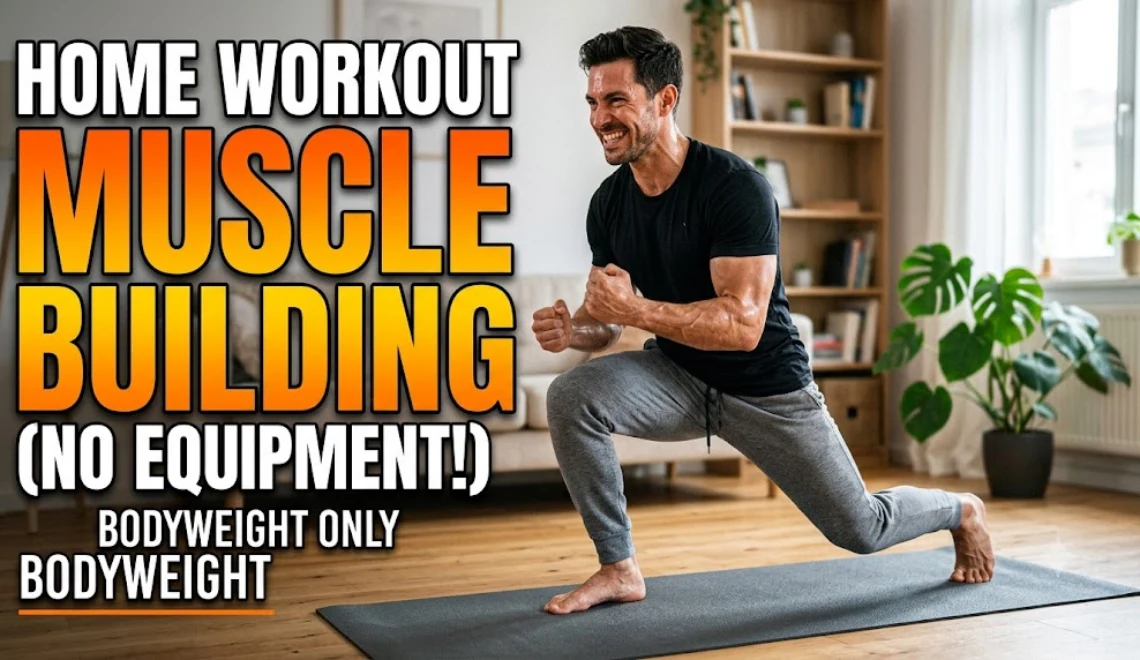
Build Muscle at Home Without EquipmentA home workout without equipment is an excellent solution to help you to achieve muscle and fitness goals. If not attending the gym makes it a bit tricky in developing new and solid muscle, or maybe you are at the start and want to do body weight exercises this solution can assist in gaining mass. Even although resistance training in a gym has got several pluses, working out with body weight alone should help to acquire new lean mass too; given you follow the suitable way and methods of gradual development.
Body Weight Strength Training BenefitsFor those people who desire to engage in the use of home exercises or are newly commencing their fitness journey to construct muscles at home; body-weight strengthening workout routine helps in improving overall fitness level; pro-enhancement of muscular endurance, develop functional fitness, improve balance, and achieve general welfare.
That said; remember building substantial amount of muscle can get long in terms of process; you need constant workout sessions, proper nutrition, and rest.
This Article Is Part of the Fitness Tips Hub
Discover proven fitness strategies, workout plans, strength training techniques, cardio exercises, recovery tips, and healthy lifestyle advice in our Fitness Tips Hub.
What is a no-equipment at-home workout to build muscle?
A no-equipment at-home workout is basically resistance exercise that uses the weight of your body as resistance. Exercises should utilize various body parts (multiple muscle groups) by working to improve their strength.
How does one get stronger using only body weight for resistance?
The more you want to challenge your muscles, one of three methods would be used:
- Performing more repetitions
- Increasing workout volume
- Slowing movement tempo
- Using single-limb variations
- Reducing rest periods
Definition at a Glance
- Uses bodyweight as resistance
- Supports strength development
- Suitable for home training
- Builds functional muscle
- Requires little space
- Ideal for beginners and intermediate users
Bodyweight Muscle Building Benefits
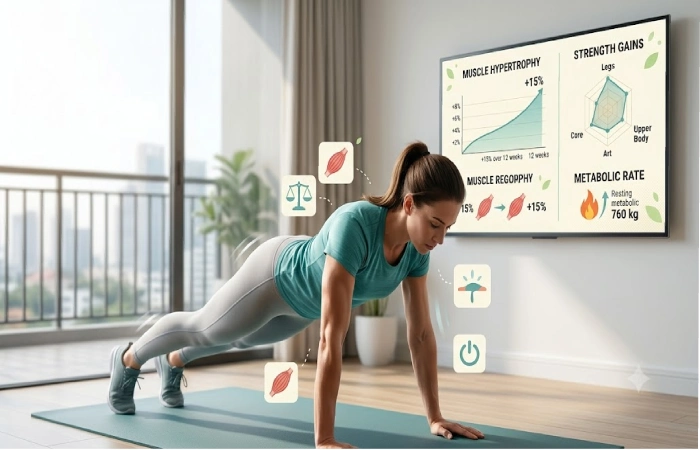
Beyond muscles, bodyweight strength building also offers a variety of other benefits.
Develops Functional Strength
They promote efficient movements fordaily tasks by encouraging muscle/joint coordination and flexibility.
Builds Lean Muscle
Progressive bodyweight training can increase muscle size, particularly for beginners and individuals returning to exercise.
Increased Joint Stability
Complex movements work stabilizing muscles to the sides of all the large joints of your body. This translates to an increased sense of stability.
Strengthens Balance and Coordination
When bodyweight exercises require significant stability, they often increase both.
Accessibility Cheap
Body weight is inarguably the cheapest and most convenient way you’re ever going to pack on some muscle, especially compared to paying some monthly to the gym, or spending thousands of dollars on workout equipment.
Home Strength Workout Routine
Complete the following circuit three to four times.
| Exercise | Repetitions |
|---|---|
| Push-ups | 10–15 |
| Bodyweight Squats | 15–20 |
| Walking Lunges | 12 each leg |
| Pike Push-ups | 8–12 |
| Glute Bridges | 15 |
| Superman Hold | 30 seconds |
| Plank | 45 seconds |
| Diamond Push-ups (Optional) | 8–10 |
Take 60 to 90 seconds rest between every 2 sets. Focus more on controlled slow movements, rather than speed.
Top Bodyweight Exercises to Gain Muscle.
Push-up
This is arguably the best bodyweight exercise for strengthening the upper body and could be done from anywhere.
Target Muscles
- – Chest
- – Shoulders
- – Triceps
- – Core
To progress, raise your feet or perform diamond push-ups.
Squats (Bodyweight)
Leg squats are effective for building lower-body strength, while also improving flexibility.
Target Muscles
- – Quadriceps
- – Hamstrings
- – Glutes
The key is to go slow during the lowering part of the exercise.
Walking Lunges
Walking lunges will test your balance and strength each leg individually.
Pike Push-Ups
Pike push-ups can improve shoulder strength and they are the best body weight exercise for upper body strength.
Glute Bridges
This posterior chain focused exercise is great for building the buttocks. Remember to squeeze the glutes as hard as possible at the top of each rep.
Superman Hold
Superman is a good exercise for helping endurance within the lower back and improving posture.
Plank
A core strengthener, planks also help build shoulder strength and stability while keeping you from creating a curve in your back.
Bodyweight Strength Exercises Weekly Plan
| Day | Activity |
|---|---|
| Monday | Upper body workout |
| Tuesday | Lower body workout |
| Wednesday | Recovery and stretching |
| Thursday | Full body strength workout |
| Friday | Core and mobility |
| Saturday | Full body workout |
| Sunday | Rest |
Ensure sufficient recovery time by giving yourself at least 48 hours between training same muscle.
Progressive Resistance Training for the Home
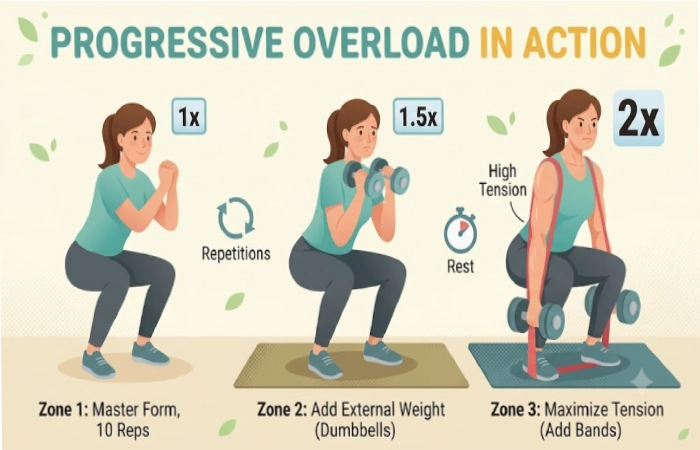
Muscles become stimulated through when the effort is steadily increasing over a workout or training sessions.
You can increase workout difficulty by:
- Performing more repetitions
- Increasing workout rounds
- Slowing the lowering phase
- Holding positions longer
- Progressing to harder exercise variations
- Reducing recovery time slightly
Progressive overload is essential for continued muscle development.
Bodyweight Training vs Weight Training
| Feature | Bodyweight Training | Weight Training |
|---|---|---|
| Equipment Required | None | Dumbbells, barbells or machines |
| Cost | Free | Equipment or gym membership |
| Functional Strength | Excellent | Excellent |
| Muscle Growth | Good for beginners | Greater long-term potential |
| Convenience | High | Moderate |
| Progressive Resistance | More limited | Easier to increase |
Muscle Building Workout Procedure.
Step 1: 5-10 min Warm-up Dynamic stretching, use full range of motion of muscles to warm up body and increase blood flow to muscles & light cardio Jumping Jacks/ Jog in Place; raise heart rate
Step 2: Compound Movements when muscles have the most energy Pushups, Squats, Lunges
Step 3 – Add on Core Muscles: Planks engage core, then lengthen the neck and let the arms go slack and lower back exercise
Step 4—Cool-Down Stretch the muscles that were worked during your workout.
Step 5 – Recover Ensure your intake of high protein, fluid, and rest.
What Results Can You Expect?
Building muscle naturally requires patience.
After 2–4 Weeks
- Improved movement quality
- Increased muscular endurance
- Better exercise technique
After 6–8 Weeks
- Noticeable strength improvements
- Better muscle definition
- Increased confidence
Then, after 12 Weeks and Beyond
- Visible muscle development for many beginners
- Improved posture
- Better functional fitness
Results vary depending on:
- Training consistency
- Protein intake
- Sleep quality
- Genetics
- Overall calorie intake
- Recovery
Tips on nutrition for muscle growth
Training is not enough to make you musclebound, support it with correct nutrition.
- High quality protein
- Complex carbohydrate
- Healthy fat
- Fruit & Vegetables
Adequate amount of water.
For 1.2g – 2.0g of protein, per KG of body weight daily; based on training level.
Harvard Health recommends progressive overload, proper recovery, and adequate protein intake to support muscle growth and long-term strength development.
How to Train to Build Lean Muscle
Avoid these common mistakes:
- Skipping recovery days
- Poor exercise technique
- Training without progression
- Eating too little protein
- Not sleeping enough
- Expecting rapid muscle growth
Advantages and Limitations
Advantages
- No equipment required
- Improves functional strength
- Suitable for beginners
- Cost-effective
- Convenient home workouts
Limitations
- Progressive resistance eventually becomes limited
- Advanced muscle growth often benefits from external weights
- Requires discipline and consistency
Who Should Try This Workout?
This programme is suitable for:
- Beginners
- Intermediate exercisers
- Students
- Busy professionals
- Travellers
- Anyone starting strength training at home
When to talk to your health care provider
Talk to your doctor before you start resistance training if:
- Have cardiovascular disease
- Recently had surgery
- Experience chronic joint pain
- Have uncontrolled medical conditions
- Are pregnant or recovering after childbirth
FAQs
Can home workout for building muscles be done without any equipment?
Yes, a home workout to build muscles can enhance your muscles’ size as well as help you gain strength, particularly when you are relatively new to lifting and working out. The principle of progressive overload, high protein intake, proper recovery and routine exercise routine can all have an effect and yield visible results.
Does bodyweight training build muscle?
Yes, for most beginner’s the body weight of exercises such as push ups, squats, lunges, or pike push ups can provide enough resistance to produce results as you begin your strength training journey.
I workout 3 days week so can you use those days and create a routine for me.
It may take the average person 4 to 7 training days a week with adequate time for rest between each session.
Is protein really that important for building muscle?
Yes. Protein supplyesthe aminiacidsnecessaryto help rebuildmuscle after you workout.
Will eventually find myself need weights?
Some will continue advancing using further advanced techniques for bodyweight exercises, eventually many advanced practitioners will eventually benefit using some external means of adding a resisted element, be it weighted or through exercise band assistance, that would help continue their muscular development.
Conclusion
No equipment bodyweight muscle building workout – laying the foundations Building a muscular body through bodyweight training can be the easiest and cheapest way you can pack on muscle mass, become leaner and stronger. When you follow a proper no equipment bodyweight workout plan withprogressive overload, adequate diet rich in protein and proper sleep, you’ll build up steadily and sustainably which would soon lead to a phenomenal Physique of yours and which will ultimately be your breakthrough. If your going to build body weight muscular training, do it in a steady and in patient way
Home Workout Without Equipment Hub
Discover the best home workouts without equipment, including full-body routines, beginner-friendly exercises, weight loss workouts, muscle-building plans, 30-minute workout routines, and effective bodyweight exercises you can do at home.