
Home Workout Without Equipment: Complete Beginner’s Guide to Building Strength and Fitness at Home
Introduction
Being able to maintain workout consistency can be a struggle, especially if your time constraints prevent you from going to the gym due to work, travel time, membership fees, or the workout area being occupied by many. Performing workouts from your house with zero equipment will help you stay active without having to buy expensive exercise machines. This form of exercise, known as bodyweight exercise, remains one of the most preferred types for many who aspire to keep their bodies active no matter how many years have passed or even if the body is a beginner.
The most obvious benefit of these exercises is how simple it is to get started—they don’t require much space, as long as you can move comfortably. Squats, lunges, push-ups, and planks use your own body weight to provide the resistance you need for developing muscular strength and endurance, coordination, and functional fitness. Although these bodyweight workouts are incredibly effective, it is wise to manage your expectations—they aren’t designed to perfectly replicate some of the advanced and highly specialized strength-training routines that are associated with lifting heavy weights, but they can be extremely helpful in helping you improve your health, mobility, flexibility, and body shape.
Learn all about training that beginners need to be aware of in terms of workout regimens, specific exercises that are to be incorporated, the advantages and disadvantages, as well as advice in order to maintain the urge to work out.
This Article Is Part of the Fitness Tips Hub
Discover proven fitness strategies, workout plans, strength training techniques, cardio exercises, recovery tips, and healthy lifestyle advice in our Fitness Tips Hub.
Home workout without equipment – what is it?
A workout without equipment is essentially exercises with their own body weight for resistance. Rather than with weights or equipment, they work natural motion patterns, improve mobility and also balance.
Common exercises include:
- Push-ups
- Squats
- Lunges
- Planks
- Mountain trekkers
- Burpees
- Glute bridges
- High knees
- Jumping sets
- Bicycle crunches
Because all these exercises engage many muscle groups at once, they provide great workouts for the entire body.
Here’s why even more individuals are selecting a no-gear training exercise
When more individuals choose the bodyweight training option it might be due to a range of factors.
Budget-Friendly
When gyms and exercise equipment can be an expense, you do not have to spend more for a way to stay healthy. Working out using your own weight also takes away the cost of having to go somewhere to work out.
Exercise anywhere
You do not need a lot of equipment to work out. You can exercise at home. When you are at the hotel. The workout is easy. You will not get too hot or sweaty. This is really good because you do not have to carry a bag of stuff with you when you travel to the hotel. You are all set for a workout wherever you are, whether that is at home or at the hotel.
Great for Beginners
The vast majority of bodyweight training exercises have simple as well as difficult variations, making people at any level of fitness able to gradually advance.
Functional Strength
Bodyweight exercises tend to emulate how your body actually works, thus enhancing stability, coordination and how well you get through your daily activities, rather than isolations like some machines do.
Saves Time
Workout outside or get that workout at home rather than having to travel to a gym and/or set up equipment.
Advantages Of Home Workout Without Equipment
Performing a routine home workout without equipment offers benefits other than the improvements of the body.
Stronger push-ups
For a better push-up: push the sets you are doing with another kind of push-up that will work out whole body, including squats, lunges, push ups
Cure Cardiovascular health
Bodyweight circuit-style exercise is great to give you a boost on the cardio level and get your heart racing.
Improved Movement Through Your Joints
As you dynamically move through various bodyweight exercises, you’re slowly and surely increasing the mobility and flexibility within your joints.
Better balance
Single-leg movements and core exercises help build up body stability, preventing many injuries.
Body Weight Loss
A bodyweight workout program with a good diet is effective for calorie consumption and maintaining proper body mass.
Better Mental Well-Being
A well-known side effect of physical exercise is that it reduces your stress levels, increases your feelings of happiness, and makes you better able to get to sleep at nighttime.
Bodyweight Workout vs Gym Workout
| Feature | Bodyweight Workout | Gym Workout |
| Equipment Required | None | Machines or weights |
| Cost | Very low | Membership or equipment purchase |
| Convenience | High | Moderate |
| Strength Progression | Moderate | Excellent |
| Muscle Isolation | Limited | Extensive |
| Functional Fitness | High | Moderate |
| Travel Friendly | Excellent | Poor |
| Beginner-Friendly | Excellent | Good |
Both are suitable choices; it depends upon how to apply either method.
Bodyweight exercises help improve strength, endurance, balance, and flexibility without requiring expensive gym equipment. As explained by Harvard Health, bodyweight training can be an effective way to build functional strength and improve overall fitness.
The muscles that were hit in that full-body, no-equipment routine
The misunderstanding of the myth: It is not true that doing bodyweight exercises can only effectively affect certain parts of muscles. In fact, when designed correctly, the entire body is used.
Upper Body
- Chest
- Shoulders
- Triceps
- Biceps (indirectly)
- Upper back
Core
- Rectus abdominis
- Obliques
- Lower back
- Transverse abdominis
Lower Body
- Quadriceps
- Hamstrings
- Glutes
- Calves
- Hip stabilisers
You’ll be engaging multiple muscle groups at once when you choose compound moves, and it will save you time as well.
8 exercises you need to do when you’re training from home!
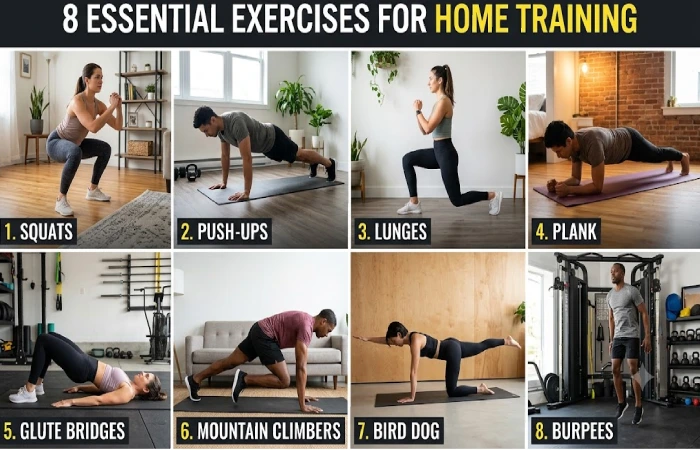
1. Bodyweight Squats
Muscles worked:
- Quadriceps
- Glutes
- Hamstrings
How to perform:
- Stand shoulder-width apart.
- Push hips backwards.
- Bend knees until thighs are nearly parallel.
- Drive through your heels.
- Return to standing.
Newbies can begin with up to 10 to 15 repetitions.
2. Push-Ups
Muscles worked:
- Chest
- Shoulders
- Triceps
- Core
When you can’t get enough quality reps with regular pushups, start by inclining the pushups or go with knee pushups. Give your best to achieve 8 to 12 reps along with maintaining a good form.
3. Forward Lunges
Muscles worked:
- Glutes
- Quadriceps
- Hamstrings
Bring your leg forward, and descend into the movement by lowering your body until your knees are both bent about 90 degrees, and push back into starting position.
Repeat on both legs.
4. Glute Bridges
This exercise strengthens:
- Glutes
- Hamstrings
- Core
Hold the top position for two seconds before lowering.
5. Plank
The plank develops:
- Core stability
- Shoulder endurance
- Lower back strength
Hold for 20 to 30 seconds in the beginning, then slowly start increasing as needed the time you take to hold.
6. Mountain Trekkers
This is a widely performed cardio and core workout.
Benefits include:
- Improved endurance
- Increased calorie burn
- Better coordination
Begin with 20 to 30 seconds.
7. Jumping Sets
An excellent warm-up movement that:
- Raises heart rate
- Improves coordination
- Increases blood circulation
- Perform for one minute.
8. Burpees
A burpee is one heck of a full-body move!
They improve:
- Cardiovascular Health
- Muscular stamina
- Coordination
Beginners can remove the jump until comfortable.
Sample daily home workout routine
These are good 25-30 minute routines to start.
| Exercise | Repetitions |
| Jumping Sets | 60 seconds |
| Squats | 15 |
| Push-Ups | 10 |
| Lunges | 10 each leg |
| Glute Bridges | 15 |
| Mountain Trekkers | 30 seconds |
| Plank | 30 seconds |
Complete 3 rounds with 60–90 seconds of rest between rounds.
Weekly Beginner Home Workout Schedule
| Day | Focus |
| Monday | Full Body |
| Tuesday | Walking + Stretching |
| Wednesday | Full Body |
| Thursday | Core + Mobility |
| Friday | Full Body |
| Saturday | Light Cardio |
| Sunday | Rest and Recovery |
When our body goes through strenuous activity and then gives rest to our muscles, recovery is crucial because our muscles develop more through rest and recuperation and less when they are worked out.
How to Build Home Workout Without Equipment
The most asked question is, “What if I don’t want to increase the weights?”
Here are effective progression methods:
Make Extra Repetitions
Increase from 10 to 20 repetitions over few weeks.
Increase Sets
Progress from two sets to four or five sets.
Reduce Rest Time
Shorter rest periods increase workout intensity.
Slow the Tempo
Be sure to descend slower when you’re doing exercises like squats and push ups to further increase your time under tension.
Try Advanced Variations
Examples include:
- Decline push-ups
- Bulgarian split squats
- Glute bridges with a single leg
- Side planks
- Jump squats
These progressions allow continued improvement even without equipment.
Then, what are the results from bodyweight exercise?
With bodyweight exercises you do at home, you can see some pretty good results, but these results will depend a lot on what you eat, how many hours you sleep, how often you work out, and your fitness level.
Your results with bodyweight exercises done at home should include higher levels of energy and coordination, in addition to improved muscle endurance, as early as within a couple of weeks.
Noticeable differences in muscular definition or body shape tend to occur later and vary depending on your genes and your body.
Eventually, you will get the maximum strength or muscle that your bodyweight exercises can deliver, and you will have to turn to resistance training to achieve anything beyond that. Progress gradually rather than in large strides.
Home Workout Without Equipment Common Mistakes
The easiest workouts, or bodyweight exercises, are actually subject to a wide range of beginner mistakes that compromise a person’s progress or even pose a risk for injury. Acing them from the beginning can prevent that.
Skipping the Warm-Up
Jumping into an extreme workout on a cold body, you’re shocking your muscles and joints without any notice of what’s about to go down. 5 to 10 minutes of light cardovascular activity & dynamic stretching will get your joints and muscles up to speed.
Simple warm-up activities include:
- Marching in place
- Arm circles
- Hip rotations
- Leg swings
- High knees
- Bodyweight squats
Using Poor Technique
Having a few extra reps in poor form does not offer any additional advantage over a few less in perfect form. Bad technique can stress your knees, back, and shoulders and is not required, so test whether or not you are using the best technique, and if in doubt, film or practice with a mirror.
Doing Too Much Too Soon
Beginner Exercising Motivation for the beginners will naturally make them think that one day of exercise at top gear and that will be it! Of course motivation works, but this will lead you to exhaustion, or you might have injuries if you practice more than you actually should be. Work three to four times a week and add more exercise days as your endurance improves.
Ignoring Recovery
Recovery is an imperative step for any fitness program. During workout recovery muscle cells regenerate and adjust themselves, which is exactly the same vital stage as the exercises performed.
Aim for:
- 7–9 hours of quality sleep each night
- Sufficient hydration
- Nutrition, balanced
- At least one full rest day each week
Following Random Online Workouts
You don’t need to try every workout you find online. Just because it’s out there doesn’t mean it’s right for you. Stick to your level and find something where it spells out each exercise rather than starting out trying things like this.
Equipment-Free Workout Safety Tips
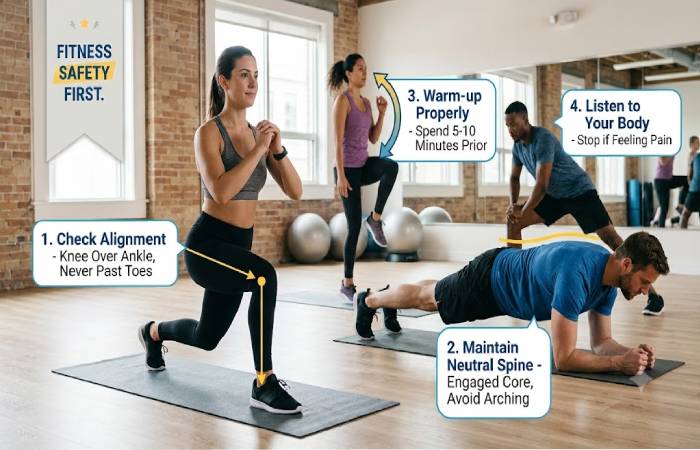
The good news is that there are few places equipment-free training is not applicable, but we all need to maintain the importance of staying safe.
Exercise in a safe environment
The area chosen should allow you to move with freedom and ease. Move the rugs and furniture and unplug the wires so that the wires can cause tripping hazards.
Use Supportive Training Shoes
By using health-benefited, feet-supportive shoes, you can be tension-free if the floor is hard or slick; wearing these supportive trainers will give satisfactory cushioning that will decrease the risk of pains in your body joints.
Drink Water Frequently While Doing Workout
Water not only helps maintain your body’s equilibrium before and after training but also when the workout becomes intense and the body sweats in high temperatures.
Notice your body.
If you feel tired during your workout or have sharp pains and chest pains. And also, if you notice things that are abnormal, you should get some rest and surely consult a physician if it’s increasing.
Increase Workout Gradually
Don’t make huge jumps in the repetitions of the exercises you do and how many exercises you can handle during each session; you will only increase the workout too much, so fast. You have to progress the workout by degrees.
Doing Your Home Workout with No Usage of Equipment
Combining exercise & diet is important for maintaining good health & fitness levels. You simply can’t achieve excellent results with any training program if you consistently fail on the nutrition front.
Top It Up with Protein
Proteins help build muscle. They also repair the damaged muscle after you do your workout. Muscles need proteins to get fixed after your workout. Proteins are really good, at building muscle and fixing the muscle that gets damaged when you workout.
Examples of protein-rich foods:
- Eggs
- Fish
- Chicken
- Lentils
- Chickpeas
- Greek yoghurt
- Tofu
- Milk
Have a protein source in each of your meals, as best you can.
Compound Carbohydrates
By name only, you might notice that carbs give you power and the energy that makes your workout work!
Good choices include:
- Oats
- Brown rice
- Wholemeal bread
- Sweet potatoes
- Fruits
- Vegetables
Include Healthy Fats
Hormone production depends on the inclusion of healthy fats in your diet for best function.
For example:
- Nuts
- Seeds
- Avocados
- Olive oil
- Drink Enough Water
Dehydration contributes to many issues, including temperature, circulation, and muscular performance regulation, and while individual amounts will differ, most adults benefit from drinking water from one stop to another over the span of the day and waiting to get to be able to be thirsty for them to drink drinking water.
Is a bodyweight workout effective in building muscle?
One of the biggest questions on a lot of people’s minds (especially newcomers to a workout routine) is can you build a lot of muscle from bodyweight training?
My answer: Yes, however, not with unreasonable expectations.
When you do a bodyweight workout, your body works with the resistance of your own mass; when this increases, it becomes stronger.
Beginners often notice improvements in:
- Muscle tone
- Strength
- Endurance
- Posture
- Balance
With respect to building serious mass, the secret is with a program that is geared to build in stages by placing higher and higher stress and tension onto the muscle to ensure constant gains. If regular exercise becomes to simple, then one has to progress onto another movement or add additional resistance to gain muscle.
Progressions beyond the beginner level
Once you get accustomed to basic exercises, you may challenge your skills with more difficult variations of exercises.
| Beginner Exercise | Advanced Variation |
| Squat | Jump Squat |
| Push-Up | Decline Push-Up |
| Plank | Plank with Shoulder Taps |
| Glute Bridge | Single-Leg Glute Bridge |
| Lunge | Bulgarian Split Squat |
| Mountain Climber | Cross-Body Mountain Climber |
These variations make your workout harder without needing any machines from the gym. The variations increase the intensity of your training without requiring gym equipment.
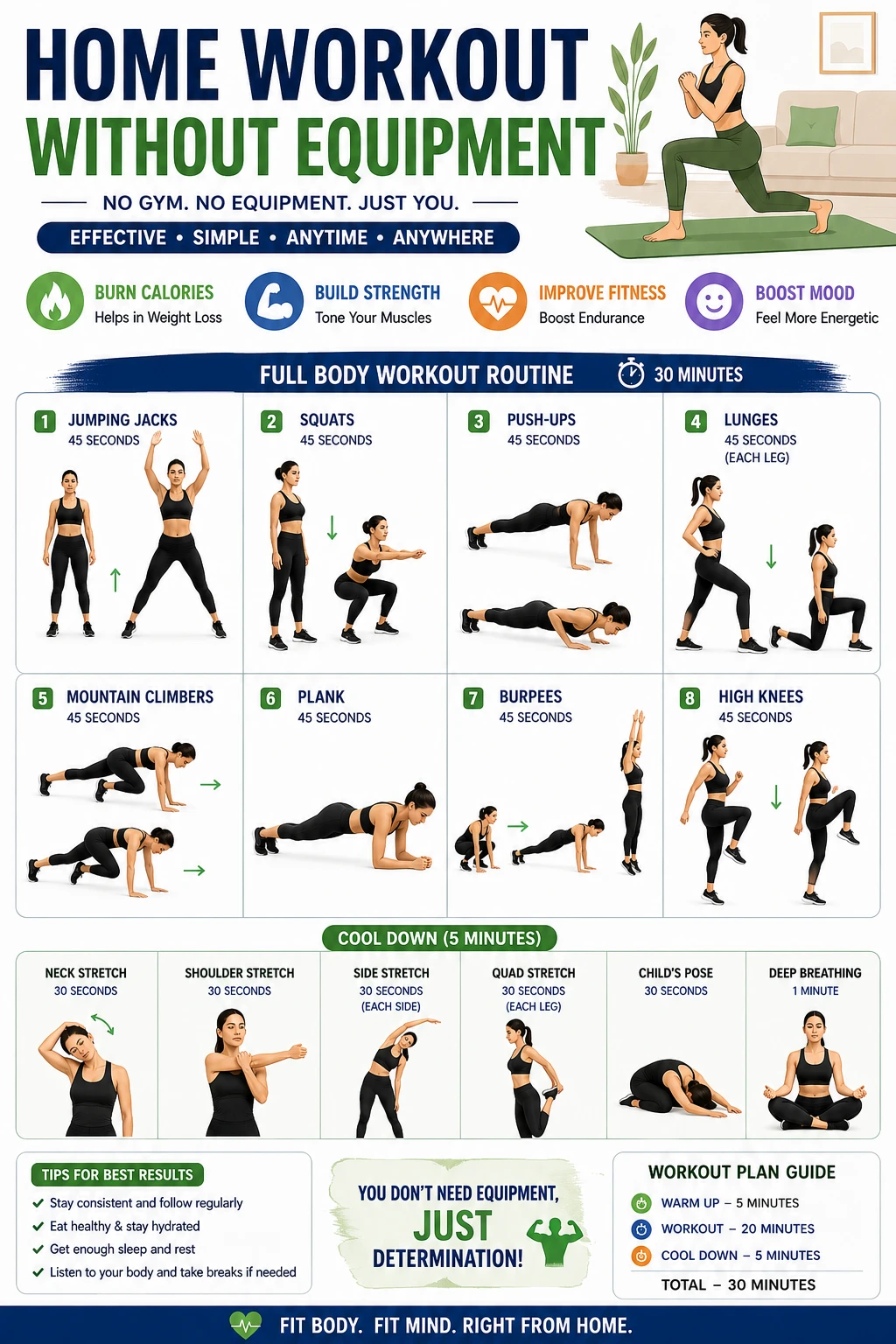
20-Minute No-Equipment, Full-Body Workout
Save time with this efficient circuit for a full-body workout.
| Exercise | Time |
| Jumping Jacks | 1 minute |
| Squats | 15 reps |
| Push-Ups | 10 reps |
| Lunges | 12 each leg |
| Mountain Climbers | 30 seconds |
| Plank | 30 seconds |
| Burpees | 10 reps |
Do this three times a week, taking a 60-second rest between rounds.
Daily At Home Workout Routine Tips – Daily How to Work Through It
For consistency, the best form of fitness for life Is one which is maintainable And sustainable And not about perfection
Ways To Stay Consistent with Your Workouts:
- Schedule workout days like high-priority appointments—stopping your calendar
- Write your workout routine down. That can be physically written, on the go in an app, or digitally saved in a journal.
- Store a fully stocked gym bag in the trunk.
- Give yourself a goal each week that’s not too hard.
- Recognize progress with strengths and stamina increases, not only with visible strength.
Workout in real time. The gym is great, but you want a place that your friends and family members can work out and exercise along with you in real time. Of course, life happens, so if you can’t attend every session, don’t fret—just get back to work where you left off and strive for progress over perfection.
Commonly Asked Queries
Can I lose weight exercising at home with a workout without equipment or weights?
Yes, you could lose weight if you work out at home without weights, as you may be burning additional calories and making yourself more and more fit. When you are combining this sort of regular workout program with correct diet and also eating correct calories, the weight could eventually come off without needing crash diets, etc.
Can I get stronger than a person who lifts?
YES. Especially if you are a beginner, you are still going to be getting stronger with bodyweight training. As your training continues, you are going to just be able to make the workout a harder workout.
Home workouts for beginners usually lasts how long?
20-40 minutes is enough for you.
Do I need supplements?
For most people you should be getting all your nutrients through your diet, only taking supplements when advised by your Doctor or a Registered dietitian.
Do beginners have to exercise a few times a week?
For beginners, working out 3–4 times a week with a proper strength training workout is totally alright.
Are old people allowed to do bodyweight exercise?
Quite often, but if you have a medical condition or mobility problem, then it’s probably advisable to seek advice from your doctor first if you are undertaking a new exercise program.
Conclusion
Home equipment-free workouts for most of us are one of the easiest and most straightforward workouts available to supercharge our fitness. Whether your goal is strength building, gaining muscle, improving endurance, increasing mobility, or enhancing range of motion, or if you are looking to maintain an active, mobile lifestyle, it all really boils down to the fact that training with your own bodyweight at home is one of the most effective means of attaining success.
The best thing about the home-based training plan that involves absolutely no equipment? This allows you total freedom. This form of training can be completed anywhere you choose—in your lounge, garden, office, or even out in a faraway land when you’re traveling—and it takes no effort as you won’t need to acquire any expensive gym machines or subscriptions.
Home Workout Without Equipment Hub
Discover the best home workouts without equipment, including full-body routines, beginner-friendly exercises, weight loss workouts, muscle-building plans, 30-minute workout routines, and effective bodyweight exercises you can do at home.